

You're standing under the bar again. You chalk up, jump or step to it, and the rep dies halfway because your shoulders shrug, your grip slips, or the whole thing turns into a swing you didn't mean to create. That's not a “women can't do pull ups” problem. It's usually a technique problem first, then a strength problem.
For women in pull ups, the fastest path isn't endless lat pulldowns and random band work. It's learning how to own the bar path, choosing the right grip, and building the rep in a sequence that doesn't waste months on junk volume. The difference matters because everyday female strength standards still show a wide gap between recreational and advanced pulling levels, with 6 pull-ups landing at “Intermediate,” 12 at “Advanced,” and 19 at “Elite” in the Strength Level dataset that aggregates 127,994 female results (Strength Level pull-up standards).
Table of Contents
- Why Most Women Stall Before Their First Pull Up
- The Four-Phase Progression to Your First Strict Rep
- Choosing the Right Grip for Your Shoulders
- Programming Pull Ups Into Your Week
- Common Mistakes Women Make at the Bar
- Breaking Through Plateaus Without Burnout
- Your 90-Day First Pull Up Checklist
Why Most Women Stall Before Their First Pull Up
You don't usually fail your first strict pull up because your back is weak. You fail because you've never learned how to hang, brace, and pull in the same line. That's why so many women can get stronger in the gym and still miss the first rep.
The cleanest way to think about it is simple. A pull up is a skill layered on top of strength, not a pure upper-body contest. In one controlled three-month program, college-age women improved upper-body strength by 36%, yet only 4 of 17 participants could finish even one strict pull-up at the end, which shows that general strength gains don't automatically transfer to strict vertical pulling (PubMed study). That is the primary reason generic upper-body work stalls.
The usual breakdown happens in three places
First, the bottom position is sloppy. If your ribs flare and your shoulders hang loose, you start every rep from a bad position and give up all the power. Second, the descent is uncontrolled, so you never teach the same path twice. Third, the grip loads your wrists and forearms before it loads your lats.
Practical rule: if the setup is messy, the rep is messy. Fix the start, and the rest gets easier.
The historical record backs up the idea that pull-up capacity is trainable, not fixed. Female endurance pull-ups have moved from hundreds to thousands of reps across record sessions, from Eva Clarke's 725 pull-ups in one hour in 2016 to Olivia Vinson's 7,079 pull-ups in 24 hours in 2025 (recordholders.org). That's not the same event as your first strict rep, but it proves one thing clearly. Pull-up performance can be built.
Band rows and lat pulldowns still have a place, but they don't teach the exact bar path you need. Stop treating them like magic. Start treating the pull up like a movement you have to learn, then layer the muscle on top.
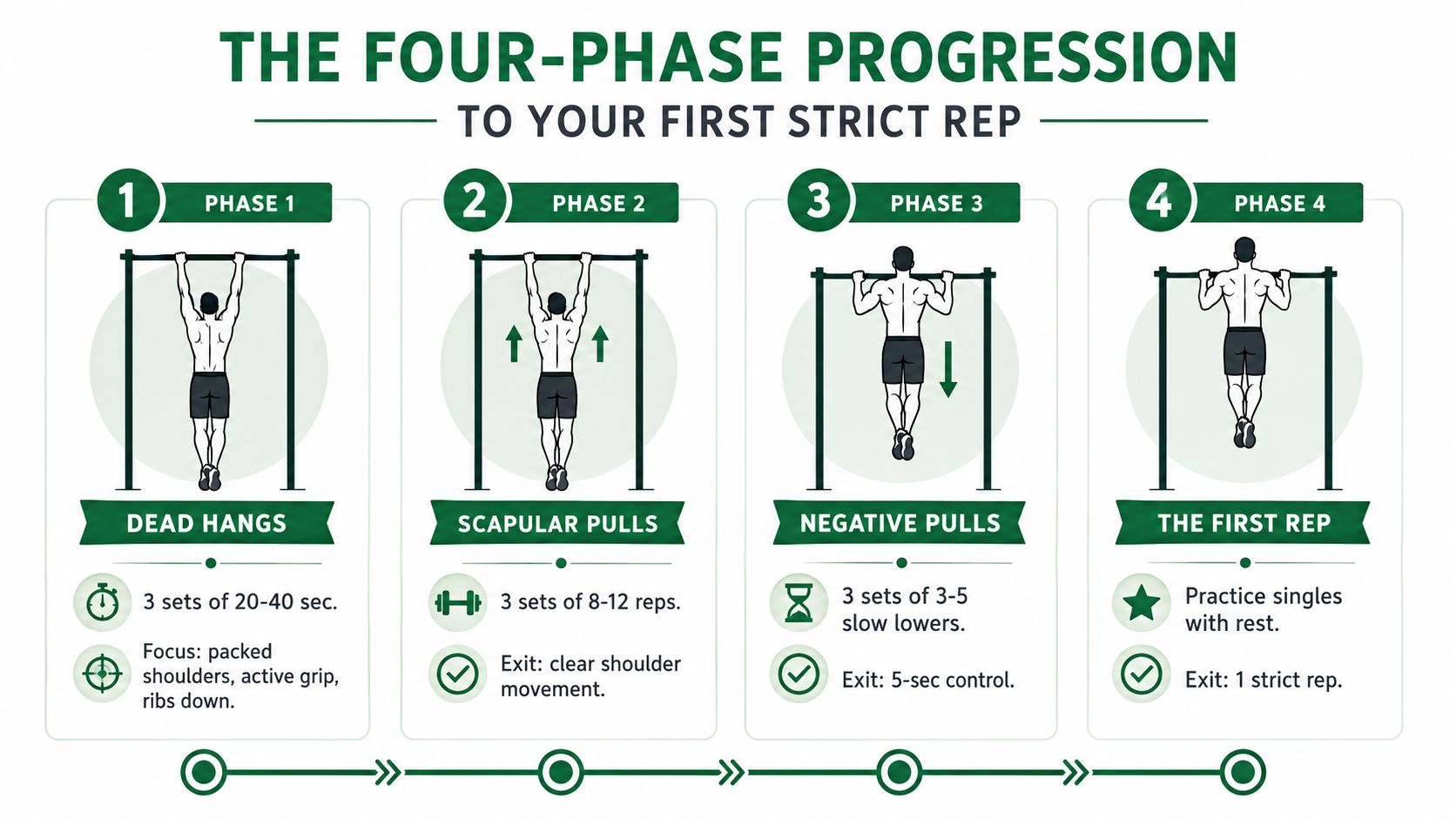
The Four-Phase Progression to Your First Strict Rep
Phase 1, own the hang
Start with dead hangs for 3 sets of 20 to 40 seconds. Packed shoulders. Active grip. Ribs down. If you can't control the bottom position, nothing else matters yet.
Use the hang to teach two things at once. You're building grip tolerance, and you're learning to keep the shoulder blades from collapsing. The body should feel long, but not limp. If you feel your shoulders drifting up toward your ears, you're not hanging, you're shrugging.
Phase 2, lower under control
Move to slow negatives for 3 to 5 reps per set, with a 3 to 5 second lowering phase from chin over the bar to full lockout. Use a box or bench to get to the top, then own the descent. Don't jump and bounce.
The target here is control, not soreness. If you can't lower yourself smoothly, you're not ready to chase full reps yet. The chin should travel over the bar, then the chest should stay organized as you descend. Keep the hollow body shape, ribs tucked, legs quiet.
Phase 3, use assistance without cheating
Use a band or partner for 4 sets of 3 to 6 reps. Pick a band thick enough that every rep stays clean. If the band lets you grind out a sloppy 12-rep pump, it's too much help and not enough skill work.
Here's the standard for moving on. Finish two clean sessions in a row at the top of the phase before you progress. That means the same rep quality, the same control, and no shoulder shrugging on the last rep. For a training day option, the Womens Organic Rib Tank is a made-to-order women's tank in 95% organic cotton and 5% spandex, with free U.S. shipping and 14-day returns on eligible items, so it fits the practical side of gym work without pretending to be performance equipment.
Phase 4, practice the real rep
Once assistance is no longer doing the heavy lifting, shift to singles and doubles from the floor with no help. Every rep starts clean and finishes clean. No half reps. No bouncing. No forehead-to-bar nonsense.
Non-negotiable cue: finish with the sternum moving toward the bar, not just the chin sneaking over it. That's the difference between a real strict rep and a rep that only looks close.
The exit criteria are simple. Two good sessions in a row before you advance, then one crisp rep, then another. You're training the nervous system to trust the same path every time.
The short version. Hang first, lower slowly, assist only enough to keep form sharp, then earn the first rep. Anything else is just random effort.
Choosing the Right Grip for Your Shoulders
Neutral grip should be the default for most women. Palms face each other, the humerus stays stacked better, and the shoulder usually tolerates it well. If your shoulders feel tweaky, start here.
Pronated grip, palms away, is the standard pull up and the style most coaches expect. It's the cleanest choice if you're healthy, your goal is a classic bar pull-up, and you don't need to protect an old shoulder issue. Supinated grip, palms toward you, hits the biceps hard and often feels stronger, but it can also place the shoulder in a position that aggravates impingement if you already have symptoms.
Use the grip that matches your job
If the goal is your first strict rep with the least drama, go neutral. If the goal is strict competition-style pulling and your shoulders are bulletproof, move toward pronation. Use supination only after you've built control in the other two grips and your elbows and shoulders stay quiet.
Grip width matters too. Just outside shoulder width beats a wide kipping setup every time. Wide grips shorten usable range and ask more from the shoulder than they give back.
Start narrow enough to own the line of pull. Wide grip is not a badge of honor, it's just a common way to make the rep uglier.
Don't switch grips every week because you got bored. That just muddies feedback. Pick one style, run it long enough to expose the weak link, then adjust.
The same idea shows up in training apparel choices and gym setup. If you want a broader practical breakdown of training clothes that work for regular lifting sessions, the internal guide on women's fitness apparel is here: women's fitness apparel guide. Keep the clothes simple and the grip decision even simpler.
Programming Pull Ups Into Your Week
The beginner week should not feel heroic. It should feel repeatable. Three sessions are enough if each one has a clear job and you don't turn every day into a max-effort test.
Beginner block, 3 days
Day A. Dead hangs, 3 sets of 20 to 40 seconds, then Australian rows for 3 to 4 sets of 6 to 10 reps. Rest 3 to 5 minutes between hang sets, and give yourself enough recovery on rows to keep the shoulder blades honest.
Day B. Band-assisted pull-ups, 4 sets of 3 to 6 reps, then lat pulldowns for controlled patterning. Keep the tempo smooth and stop a rep before form breaks. If you're gasping, the band is too light or you're doing too much.
Day C. Negatives, 3 to 5 reps per set with a 3 to 5 second lower, then face pulls to reinforce shoulder control. This is the day where discipline matters most. A sloppy negative teaches a sloppy pull.
Intermediate block, 4 days
Day 1 is heavier pull-up work with slow, low-volume practice. Day 2 is upper-body accessories that support the pull, not random fluff. Day 3 is lower body and core, because a stable torso keeps the pull cleaner. Day 4 is skill and volume, where you practice quality reps without chasing fatigue.
For a lighter training-day option on the lower-friction side of gym wear, MENS DAILY STANDARD TRAINING SHORTS are a made-to-order men's short with an elastic waistband, side pockets, and a shorter cut that stays out of the way during sessions.
Warm-up and logging rules
Start every session with scapular engagement, a few easy hangs, and one crisp setup rep before the working sets. If fatigue is high, cut volume before you cut form. Log the grip, the band, the hold time, and whether the rep stayed clean from bottom to top.
The point is measurable progress, not heroic fatigue. If the session turns into survival, the program is already broken.
Common Mistakes Women Make at the Bar
The first mistake is starting every set from a lazy dead hang. A relaxed shoulder looks honest, but it steals work from the lats and turns the first inch of the rep into a shrug. Fix it with one drill, a hanging start where you pack the shoulders before every pull.
The second mistake is using momentum before you own a strict rep. Kipping and swinging teach a different motor pattern, and that pattern doesn't transfer cleanly when you need one controlled rep from a dead stop. Fix it with controlled negatives from a box, not faster body English.
Don't chase the wrong target
The third mistake is pulling the chin over the bar and calling it good. That shortens the range and encourages a half rep that never develops real strength through the top half. Fix it by thinking sternum to bar, then pausing briefly at the top before lowering.
The fourth mistake is grabbing the bar with a thumbless hook too early and letting the forearm do all the talking. That can shift attention away from the pulling muscles and irritate the wrist when the load climbs. Fix it by wrapping the thumb and keeping the grip active.
Quick diagnostic: if your shoulders rise, your legs swing, or your chest never moves, the set was practice in fatigue, not practice in pull-ups.
These mistakes show up fast when people train in loose tops and oversized gear that hides body position. The article on cut out tank tops is useful if you care about how clothing affects shoulder freedom, but the bigger point stays the same. Clean movement beats clever gear.
Breaking Through Plateaus Without Burnout
Stop living on assisted reps forever. If you can do three sets of five strict band-assisted reps with a light band, the next move is to thin the band, not pile on more volume. Less assistance exposes the actual weak point faster.
If you already own one strict rep and can't get a second, don't turn the bar into a daily test. Take a short deload, then use weighted singles and cluster work so the nervous system learns to produce clean force again. Endless max attempts just make the same miss louder.
If grip is the limiter, stop pretending rows will fix it. Use a thicker bar, a mixed grip drill, or towel hangs for two sessions a week. That gives you specific grip stress instead of more general pulling fatigue.
The most common reason women stall isn't lack of effort. It's too many pulling exercises, too much frequency, and no clear decision rule for progression.
Use one rule. If form holds, reduce assistance or add load. If form breaks, reduce volume. If the shoulders hurt, switch the grip and clean up the pattern before you add anything else.
Your 90-Day First Pull Up Checklist
Weeks 1 to 3, live on dead hangs and hollow holds. Weeks 4 to 6, add slow negatives with a controlled descent. Weeks 7 to 9, layer in band or partner-assisted reps. Weeks 10 to 12, practice singles with full range of motion and no help.
Retest strict pulls only at the end of each block. Don't sneak in random midweek tests just to prove something. That usually turns training into guessing.
Your two daily priorities outside the bar are simple. Sleep at least seven hours, and keep protein at 1.6 g/kg bodyweight. If you ignore those, your pull-up work will always feel harder than it should.
The internal reference for gym basics and gear is here if you want a broader apparel context: mesh tank top women's guide. Keep the checklist on paper, not in your head.
Week 13 has one decision. Book a dead-hang test, and if it stays above 30 seconds, move to the next block with weighted work. If it doesn't, repeat phase one and earn the next step properly.
From: Me Fitness Apparel makes training clothes and athleisure for women and men, including tanks, tees, and shorts built for regular gym use. If you want apparel that fits the same no-nonsense approach as your pull-up work, visit From: Me Fitness Apparel and choose gear that stays out of the way while you train.