

Most advice on cut out tank tops is lazy. It treats them like ordinary tanks with missing fabric, then acts surprised when the straps twist, the armholes gape, or the top turns into something you only wear once. That's the wrong lens. A cut out tank top is a coverage decision, a construction decision, and, if you train seriously, a performance decision.
The first thing to understand is that intentional exposure is not the same as structural failure. The cut-out family started as a performance garment built for mobility, with roots tied to early 20th-century swimwear and pool use, not gym vanity. Historical accounts trace the name back to the era when pools were called “swimming tanks”, with the term already circulating by the 1920s and mainstream usage clear by the 1940s. That history matters because it explains why the silhouette keeps showing up in sport, athleisure, and everyday wear, it was built for movement first, not decoration. Tommy John's history of tank tops
Table of Contents
- The Reality of the Cut Out Tank Top Trend
- Four Variables That Define Your Fit
- Fabric Blends and Long-Term Recovery
- Choosing Coverage for Your Training Style
- The Case for Professional Construction
- A Century of Utility and Style
The Reality of the Cut Out Tank Top Trend
A cut out tank top is not just a sleeveless shirt with fabric removed at random. The openings are intentional, and that means the garment succeeds or fails on how much coverage it keeps where the body needs it most. Get that wrong, and you end up treating a designed silhouette like a damaged one.
Coverage is the genuine product
The market keeps selling cut out tank tops as a style choice, but shoppers are really buying a coverage profile. Some cuts stay close to the body and let you move without much side reveal. Others open the armholes, drop the sides, and push the top toward statement wear instead of a training layer.
That difference matters in the gym. A top with controlled openings keeps you cool and gives you room through rows, presses, and conditioning work. A top with sloppy geometry exposes too much and shifts under load, which is exactly what you do not want when you care about form.
Practical rule: If the top looks sharp in the fitting room but feels unstable when you raise your arms, it is not a good training pick.
Style only works when the structure holds
The modern appeal of cut out tank tops comes from the mix of airflow and shape. They look cleaner than a hacked-up shirt because the cut line, strap placement, and edge finish are designed to work together. The best versions feel intentional on the rack and stay intentional on the body.
The cut-out trend also fits the broader tank top story. Early commercial undershirts were being sold by 1928 to protect dress shirts, military use normalized the garment in the U.S. during both World Wars, and Marlon Brando's 1951 appearance in A Streetcar Named Desire turned the white tank into an icon of masculinity and athletic edge. The modern cut-out version inherits that same utility-first DNA, even when it is worn for style. The New York Times on tank tops in men's style
Four Variables That Define Your Fit
A cut out tank top only works when the geometry is right. The front view can look sharp and still fail in motion if the pattern leaves too much side exposure, weak shoulder support, or a neckline that shifts around. Judge it by strap width, armhole drop, neck trim width, and armhole trim width, because those four variables decide whether the top stays anchored or starts floating across the chest and shoulder.
The four measurements that actually matter
Strap width is the first filter. Wider straps give more shoulder coverage and more stability, while slimmer straps push the look toward openness and can make the garment feel less planted during overhead work. Armhole drop sets how far the side opening falls, and that is the fastest way to change airflow and side exposure.
Neck trim width controls how the top sits across the chest and upper torso. A tighter trim feels more contained, while a wider finish opens the upper body visually. Armhole trim width affects the finished edge, comfort against skin, and how clean the opening looks after movement and washing. Production tech-pack guidance treats these measurements, along with body length and chest width, as part of the minimum set needed to cut and grade accurately, because the garment is defined by absence as much as presence. White Cotton tech pack guidance for tank tops
| Variable | What It Changes | What To Watch For |
|---|---|---|
| Strap Width | Shoulder support and visual balance | Too thin for heavy lifting, too wide for a sharper cut-out look |
| Armhole Drop | Side exposure and airflow | Deep drops can shift during pulls and presses |
| Neck Trim Width | Chest coverage and neckline stability | A weak trim makes the front look unfinished |
| Armhole Trim Width | Edge comfort and clean finish | Narrow trim can feel cheap and distort faster |
Why the right proportion beats the trendiest look
A wider armhole might look aggressive, but it cuts away the fabric that holds the garment in place at the shoulder and chest. That makes fit errors easier to see than on a standard tank. The more you open the cut, the more exact the pattern has to be.
If you are buying for a specific body type or you need a predictable fit, use a size chart instead of guessing. The sizing reference at From Me Apparel's women's tank size chart is the kind of tool you should check before assuming a cut-out style will sit the same way on every frame.
The Daily Standard Tank sits on the safer side of this equation. It uses a regular fit, hemmed armhole edges, neck ribbing, shoulder-to-shoulder tape, and double-needle hems, which is the kind of construction that keeps a sleeveless shape honest over time.
Fabric Blends and Long-Term Recovery
Fabric choice changes everything in cut out tank tops because the openings concentrate stress at the seams and bindings. If the fabric recovers poorly, the cut-outs drift, the neckline warps, and the whole top starts looking tired long before the body of the garment should. That's why I'm hard on fabric blend, not just hand feel.
Blends keep the geometry cleaner
The market examples tell the story clearly. You'll see blends like 95% polyester / 5% spandex, 95% cotton / 5% spandex, and 50% modal / 45% cotton / 5% elastane because each adds stretch and recovery without giving up all structure. Elastane and spandex help the garment snap back, while polyester and modal can improve shape retention and softness.
That matters more in a cut-out than in a plain tank. A standard sleeveless top can get away with a little relaxation in the fabric. A cut-out tank can't, because every opening makes movement and laundering more obvious.
Buy for recovery, not hype. If the fabric doesn't bounce back after stretching, the cut-out shape won't stay crisp for long.
Shrinkage tells you how honest the fabric is
Independent tank-top testing shows the difference after laundering. A cotton-modal-spandex blend shrank 0.63%, while 100% organic cotton shrank 4.38% under the same machine-wash and tumble-dry conditions. That doesn't mean cotton is bad. It means unblended cotton is more likely to change the fit and alignment of a cut-out design after repeated care. Trendsi product and testing reference
| Fabric Blend | Shrinkage Rate | Best Use Case |
|---|---|---|
| Cotton-modal-spandex blend | 0.63% | Better for keeping cut-out geometry and neckline alignment steady |
| 100% organic cotton | 4.38% | Fine for casual wear if you accept more change after washing |
For a training rotation, I'd choose a blended cut-out before I'd choose a pure cotton one unless the cotton piece is built with strong finishing and you're mostly wearing it casually. That's the same logic behind a piece like the Daily Standard Quarter-Zip, which uses a 60/35/5 cotton/polyester/spandex blend and pre-laundered construction to keep its shape and layering profile consistent.
The broader fit and fabric conversation around performance basics also shows up in From Me Apparel's brand page on Vuori-style athletic layering, but the takeaway is simple. If a cut-out tank is going to survive workouts, washing, and repeated wear, the fabric has to recover as well as it stretches.
Choosing Coverage for Your Training Style
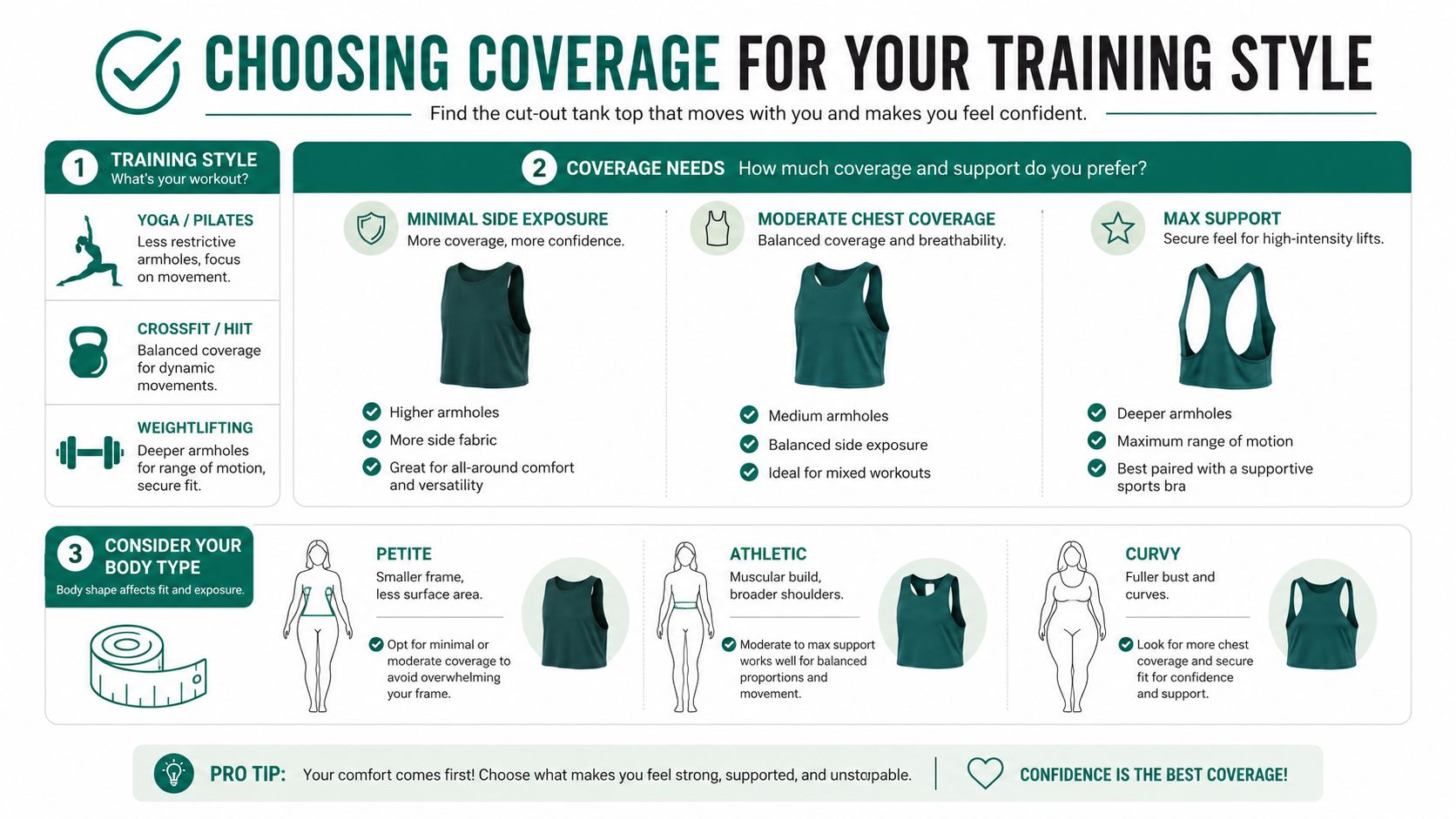
Coverage is a fit decision, not a style afterthought. A cut out tank top that looks sharp at brunch can fail hard in the gym if the armholes pull, the straps slip, or the opening shifts every time you brace. The right choice depends on how much movement your session demands and how much fabric you need to keep the silhouette under control.
Match the cut to the movement
For heavy lifting, choose steadier coverage. Wider straps give the top a better anchor point, and a higher side line keeps the armholes from flaring when you set up for presses, rows, or bar work. If your training includes overhead movement, the tank should stay centered when your shoulders open and close.
For running and other high-output cardio, you can go lighter on coverage because airflow matters and your body is moving in a more forward pattern. Even then, keep the side exposure in check. A good cut-out tank still has to stay stable when your arms swing and your torso twists.
For casual layering, more openness is fine. If the tank sits under a jacket, overshirt, or hoodie, the cut-out is doing visual work first. In that case, the priority is a clean neckline and armhole shape that sits flat instead of fighting the outer layer.
Use body type and exposure tolerance honestly
A petite frame can handle a more open cut without the top drowning the torso. Broader shoulders usually need more strap support so the garment does not creep upward during movement. Curvier bodies tend to look cleaner in cuts with more deliberate chest coverage and a controlled side opening, because random placement creates pull points that show fast.
Do not try to hide the body. Try to keep the garment from shifting every time you move. If you want a cleaner benchmark before you commit to a more open design, the Core Essentials Tank gives you a straightforward baseline for comparing fit, coverage, and silhouette.
- Yoga or mobility work: Choose armholes that let you reach without tugging.
- Weightlifting: Choose deeper openings only if the straps still hold the top in place.
- Layering days: Pick a cut that looks intentional with outerwear, not one that depends on the jacket to cover fit problems.
- Public-facing casual wear: Choose moderate exposure so the top reads polished, not unfinished.
The Running Club Hoodie sits at the opposite end of the spectrum. It is oversized, heavyweight, and built for coverage, which is exactly why a more open tank underneath makes sense in colder or transitional settings.
The Case for Professional Construction
DIY cut-offs fail for a simple reason, raw edges do not hold their shape. The first wear can look acceptable, but after that the fabric starts to curl, the arm openings stretch unevenly, and the neckline loses the clean line that made the piece worth wearing. If you want a cut out tank top to stay in rotation, construction matters more than the scissors ever did.
Finished edges beat raw experimentation
A professionally built tank gives you hemmed armhole edges, shoulder-to-shoulder tape, and double-needle hems, the exact details that keep the garment from drifting out of shape. Those features do more than look tidy. They hold the stress points together. A home-cut top usually has no real defense against fraying, especially when it gets worn for training and washed often.
That is why I push people toward pre-made pieces instead of DIY hacks. A cut-out shape is already a compromise between openness and stability, so starting with unstable edges is a bad bet. If you care about repeat wear, the shirt has to handle sweat, movement, and machine washing without turning into a different silhouette.
The fastest way to ruin a cut-out top is to treat edge finish like an optional detail.
Buy the construction that matches your habits
If you train a few times a week and want the top to stay in your drawer, buy a garment built for that job. A strong baseline is Daily Standard Tank, which pairs preshrunk combed cotton with double-needle hems and shoulder-to-shoulder tape. That kind of build keeps a sleeveless shape from collapsing after repeated use.
The same logic applies to any serious fitness wardrobe. You do not need every top to be technical, but the ones you sweat in should have clean seams, stable binding, and a cut that was designed instead of improvised. DIY works for a one-off look. It is a poor plan for a real training rotation.
A Century of Utility and Style
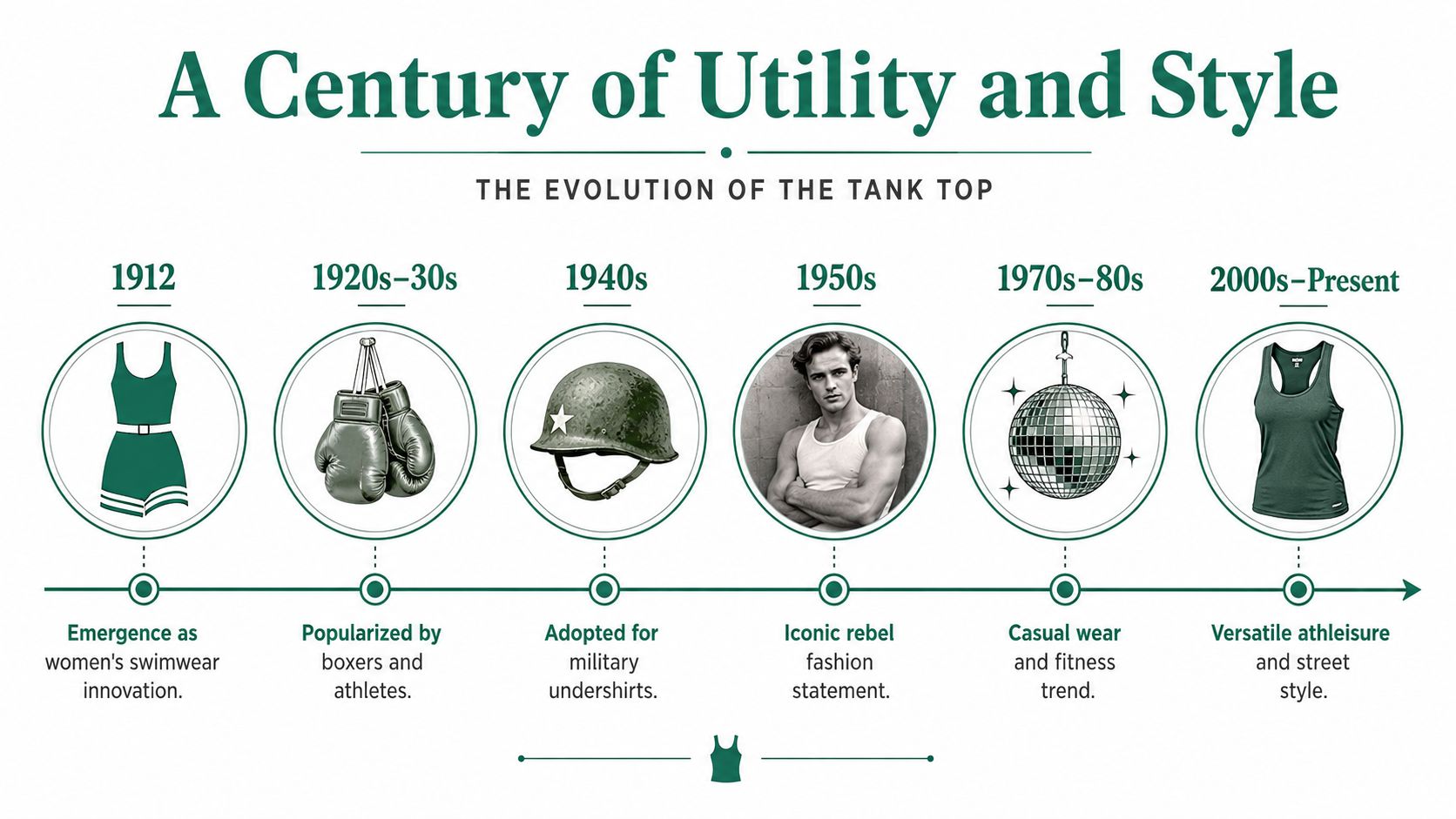
The tank top has lasted because it keeps solving the same problem in different ways, movement without excess fabric. It started in early swimwear, moved through military utility and commercial undershirts, then became a visual shorthand for confidence, discipline, and physical work. That path explains why cut out tank tops feel modern without being trendy in a disposable way.
What the timeline actually tells you
The shirt's origin in 1912 swimwear shows the core idea, free the arms and let the body move. By the 1920s and 1940s, it had already crossed into everyday dress, and by the time Brando wore it in 1951, the tank had become a cultural symbol instead of just a utility layer. That progression is why the garment still works across gym floors, sidewalks, and layered outfits.
The modern cut out tank top sits right inside that history. It's not a gimmick if the cut is deliberate and the construction is sound. It's a tool for temperature control, range of motion, and visual clarity.
If you want your wardrobe to support training instead of fighting it, buy fewer tops and choose better ones. Keep a cleaner baseline tank, add one or two cut-out options for lighter sessions or casual wear, and make sure every piece earns its place by fit and recovery, not by novelty.
From: Me Fitness Apparel builds fitness apparel that fits this exact use case, from cleaner training tanks to layered athleisure pieces that move from gym to street without looking sloppy. If you want gear that respects coverage, construction, and real training wear, browse the women's collection and build your rotation with pieces that can handle the bar, the floor, and the rest of the day.
Built with Outrank app