

You buy a T-shirt because it feels soft in the fitting room. A few washes later, the collar waves, the body twists, and the hem sits somewhere it never did on day one. That shirt wasn't necessarily cheap, and the logo certainly didn't guarantee quality.
The better question is what are the best quality men's T-shirts that still look right after repeated wear and washing? I judge a tee by its wash-life performance first, then by comfort and style. Fabric weight, fiber length, yarn quality, shrinkage control, pilling resistance, seam stability, and intended use tell you far more than a premium label.
If you need one shirt for commuting, lifting, weekends, and frequent laundry, don't choose from a single “best” list. A mid-weight cotton tee is usually the strongest all-rounder. A heavyweight cotton tee wins for structure and opacity. A polyester blend makes more sense for sweat, travel, and quick drying. The comparison below gives you the short answer before we get into the details.
| Tee type | Best use | Main strength | Main weakness |
|---|---|---|---|
| Premium mid-weight cotton | Everyday wear, office-casual outfits, layering | Breathability, balanced drape, versatile comfort | More vulnerable to shrinkage if poorly finished or dried hot |
| Heavyweight garment-dyed cotton | Streetwear, cooler weather, repeated casual wear | Structure, opacity, shape retention | Warmer, heavier, and less efficient for sweaty training |
| Polyester-blend performance tee | Gym sessions, travel, hot conditions | Moisture management, stretch, quick drying | Can feel less natural against the skin and may hold odor more readily |
Table of Contents
- Introduction Why Quality Means More Than Softness
- What Makes a Men's T Shirt High Quality
- Heavyweight Cotton Versus Performance Blends Compared
- Head to Head Comparison for Training and Everyday Wear
- Recommendations by Use Case and Fit Preference
- How to Make Quality Tees Last Longer and Cost Less
- Final Buying Checklist and Smart Value Decisions
Introduction Why Quality Means More Than Softness
A tee can feel soft on the first wear and still fail after laundry. Surface softness does not reveal whether the fabric will pill, shrink, twist, or lose its neckline. Independent textile testing evaluates dimensional change, seam stability, pilling, spirality, and bursting strength, which are more useful quality checks than a “100% cotton” label alone. The textile quality evaluation of men's cotton jersey tees shows why those measures matter.
You need a rotation that survives ordinary use, not a display collection. One tee may sit under a jacket, another may handle gym sessions, and a favorite may become your default weekend shirt. Failures usually appear after repeated washing: the collar stretches, the color dulls, the body shortens, or pills spread across high-friction areas.
My rule: judge a T-shirt by its behavior after washing, not by its luxurious feel under store lighting.
Match the shirt to the work. Mid-weight cotton jersey offers breathability and layers cleanly across seasons. Dense heavyweight cotton gives a stronger silhouette and more coverage, but it adds heat and bulk during hard training. A blended performance tee manages sweat, dries faster, and handles frequent washing practically, although its handfeel differs from cotton.
Wash-life performance also changes the value calculation. A tee that keeps its fit and surface longer can deliver a lower cost per wear, even if its purchase price is higher. For everyday use, prioritize stable construction and controlled shrinkage. For training, prioritize moisture handling and resistance to odor and pilling. For streetwear, prioritize GSM, opacity, and shape retention.
The best quality men's T-shirt is not automatically the softest or most expensive. It is the shirt whose GSM, long-staple fibers, knit construction, shrinkage, and pilling resistance suit your use case and preserve the intended fit through repeated wear and washing.
What Makes a Men's T Shirt High Quality
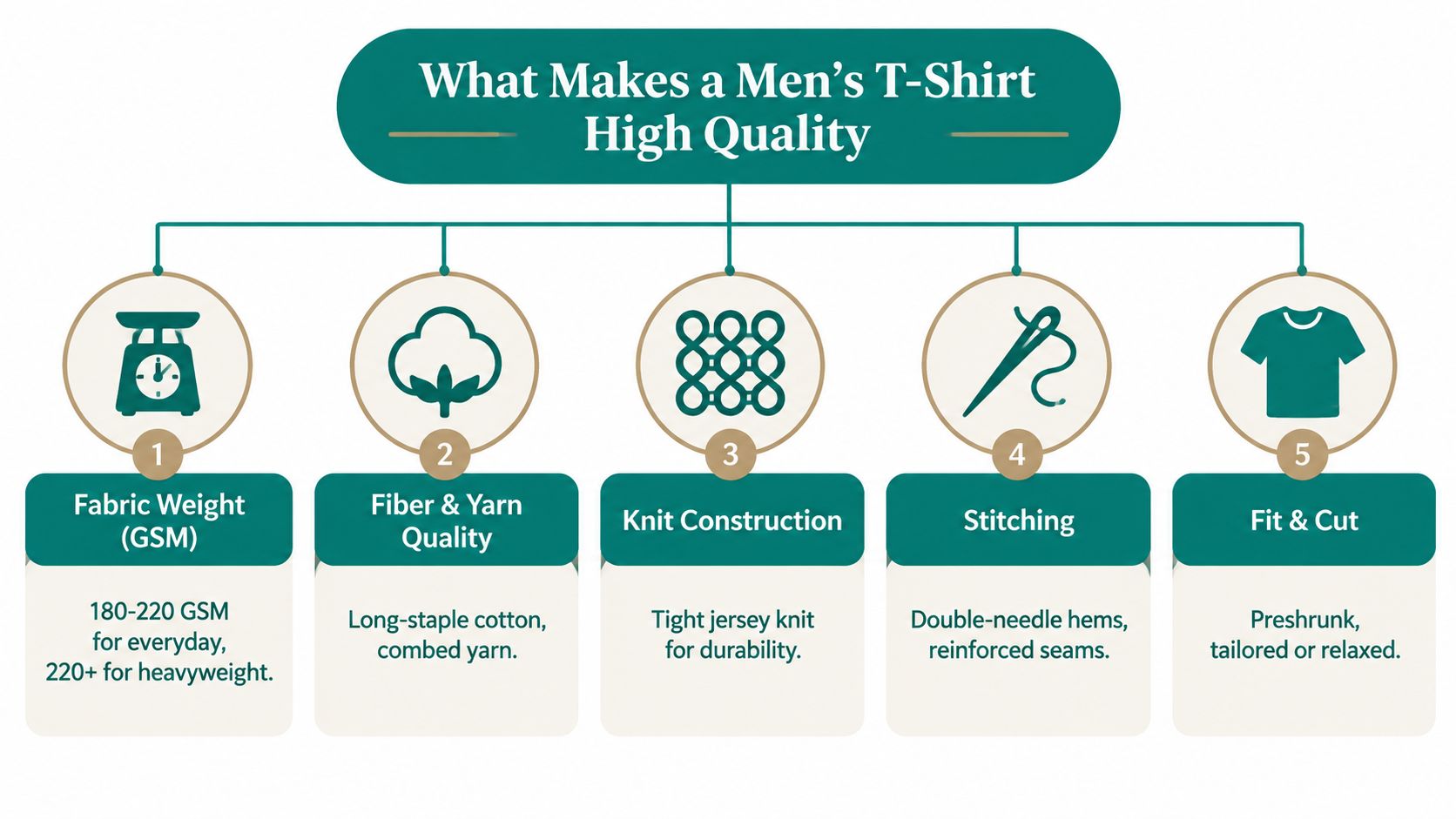
A shirt can feel soft in the fitting room and still fail after repeated washing. Judge quality through specifications and wash-life performance: fabric weight, fiber type, construction, fit measurements, shrinkage, pilling, and care instructions. A product page that explains these details deserves more trust than one built around “premium” or “luxury.”
Fabric weight in GSM
GSM means grams per square meter, a useful measure of fabric density. Industry guides commonly place everyday premium T-shirts around 160–180 GSM, while structured heavyweight shirts often begin around 200 GSM and can reach 260–300 GSM. This fabric-weight guide connects weight with opacity, drape, and durability.
For year-round wear, 160–180 GSM is the smart range. It allows airflow while avoiding the flimsy feel of ultra-light jersey. Choose heavier fabric for a boxier drape, stronger structure, or greater coverage. A 255–260 GSM garment-dyed build, such as the Leave Your Mark Graffiti Heavyweight Oversized Tee, suits a visibly heavier streetwear silhouette rather than lightweight layering.
Fiber and yarn quality
Fiber length affects the yarn and the finished surface. Textile references describe extra-long-staple cotton as roughly 35 mm and over, supporting smoother, stronger yarn with less tendency to pill than shorter-staple cotton. This comparison of men's plain T-shirts reports that Pima single jersey at 160–180 GSM reached about 14,000–18,000 Martindale cycles before visible pilling, compared with roughly 8,000–12,000 cycles for standard combed cotton in the same construction.
Look for ring-spun, combed, Pima, Supima, or extra-long-staple cotton when the product page explains how the yarn is made. “Cotton” alone leaves too much unknown.
Knit, stitching, and stability
A tight jersey knit creates a smoother surface and handles everyday abrasion better. Inspect the shoulder seams, underarms, collar attachment, and hems. Reinforced seams and clean stitching reduce stress failures in these high-pull areas.
Fit stability matters just as much. Check garment measurements instead of treating “regular” or “relaxed” as universal standards. A quality tee should retain its proportions after washing. A collar may stay intact while side seams twist or the body shortens.
Finish durability
A durable finish controls post-wash changes. Look for preshrunk or stabilized fabric, dependable collar ribbing, and care instructions suited to the material. If a product page says nothing about shrinkage, pilling, or laundering, treat that silence as missing quality information. The right tee is the one that keeps its intended fit and surface, lowering cost per wear through repeated use.
Heavyweight Cotton Versus Performance Blends Compared
Three fabric groups cover most buying decisions: premium standard cotton, heavyweight garment-dyed cotton, and polyester-blend performance fabric. The best choice depends on how you will wear, wash, and dry the tee. Judge quality by wash-life performance, not softness or brand recognition.
Premium standard cotton
A mid-weight cotton jersey is the strongest daily default. Around 160–180 GSM, it gives useful opacity and drape without excessive bulk, so it layers under overshirts, jackets, and knitwear. That balance works well for a tee you expect to wear repeatedly across casual outfits.
Cotton has a natural handfeel and breathes comfortably in ordinary conditions. Its failure points appear in the laundry. Tumble drying can cause more shrinkage than synthetic fabric, while weak construction can lead to pilling, spirality, or a neckline that loses its shape. Choose stabilized fabric and track how the body length and collar change after washing.
Heavyweight garment-dyed cotton
Choose heavyweight cotton when the tee needs to establish the outfit's silhouette. Technical classifications commonly place 185+ GSM in heavyweight territory and 240+ GSM in super-heavyweight territory. The added mass brings greater opacity, firmer structure, and a more pronounced drape. It also holds more warmth and dries more slowly. This men's T-shirt weight guide outlines these categories and connects heavier construction with longer expected service life.
Garment dye creates a broken-in appearance and may produce slight color variation between pieces. That character suits streetwear, relaxed trousers, denim, and cooler layering. Wash it carefully to protect the color and shape. I would not choose it first for high-sweat training, where drying speed matters more than substantial drape.
Polyester-blend performance tees
Blends are functional equipment. Polyester, polyamide, or elastane can improve stretch, moisture management, wear resistance, and dimensional stability. The Leeds textile durability study reports that synthetic fibers can reduce shrinkage and improve wear performance compared with pure cotton in relevant testing.
For training: choose the fabric that dries efficiently and moves with you, not the one that feels most luxurious when dry.
A performance blend is the practical pick for workouts, travel, and hot conditions. It dries faster and manages sweat better, although its surface can feel less substantial and more technical than cotton. For lower cost per wear across mixed use, keep one cotton tee for daily outfits and one performance tee for training. One fabric should not handle both jobs.
Head to Head Comparison for Training and Everyday Wear
The best tee depends on the job, climate, and laundry routine. GSM, drying speed, shrinkage, pilling, and expected wears matter more than softness alone. A heavyweight shirt can hold its shape beautifully, yet become a poor training choice if it stays damp and costs more to wash and pack.
| Tee Type | Best For | Durability and Care | Trade Off |
|---|---|---|---|
| Premium mid-weight cotton | Everyday wear, commuting, layering, office-casual outfits | Wash cold, avoid high heat, inspect collar and side seams after laundering | May shrink or twist if poorly stabilized |
| Heavyweight garment-dyed cotton | Relaxed streetwear, cooler weather, standalone wear, substantial drape | Preserve shape and color with gentle washing and low heat or air drying | Heavier, warmer, and slower to dry |
| Polyester-blend performance tee | Training, travel, hot climates, frequent washing | Follow care instructions, wash promptly after sweaty use, avoid harsh heat when possible | Less natural handfeel and a more athletic appearance |
For all-day casual wear, premium mid-weight cotton is the winner. It layers easily, suits more outfits, and avoids the excess warmth of heavyweight fabric. Check the collar recovery and side seams after washing. A tee that twists or loses its neckline quickly has a higher cost per wear, even if it felt soft on day one.
Choose heavyweight cotton when silhouette matters most. Its density supports relaxed trousers, denim, and outerwear, while garment dye adds visual character. Accept the trade-offs: more weight in your bag, slower drying, and greater heat retention. It belongs in casual wardrobes, not as a default for every activity.
For gym sessions, performance blends win on function. Sweat, friction, and repeated laundering expose cotton's limits during intense conditioning and hot-weather training. Polyester, polyamide, or elastane can improve moisture handling, stretch, wear resistance, and dimensional stability. A cotton tee still works for low-sweat strength sessions, but it is less efficient when the shirt must dry quickly. Use this men's fitness apparel guide to match the fabric with the session.
Travel also favors blends because faster drying makes limited laundry access easier to manage. Heavyweight cotton earns its place only when outfit structure outweighs packability. Wash count matters for every category. Independent testing found that some cotton jerseys changed length beyond the stated 3% ASTM D4154 dimensional-change limit after five washes, with evaluated changes reaching 7.7% and 8.8%. The practical lesson is direct: verify shrinkage control and pilling resistance before paying for a tee you expect to wear often.
Recommendations by Use Case and Fit Preference
Choose the tee by the job it must perform, then choose the silhouette. A good fabric in the wrong cut still feels wrong, and a flattering fit won't compensate for shrinkage or pilling.
If you want one versatile daily tee
Choose a 160–180 GSM premium cotton jersey with a stable collar and a clean shoulder line. This range has enough body for standalone wear but remains easy to layer. A relaxed or lightly cut will serve more situations than an extreme oversized shape.
If you work in a casual office, commute, and wear the same shirt on weekends, avoid fabric that feels overly stiff or a cut that dominates your proportions. Look for clear measurements, fiber details, and care instructions before trusting the marketing copy.
If you want structure and streetwear shape
Choose heavyweight garment-dyed cotton. The extra density gives an oversized or boxy cut the support it needs, while a drop shoulder creates a deliberate relaxed silhouette rather than an accidentally oversized shirt.
The Attack The Day Heavyweight Oversized Tee uses the same stated 255–260 GSM, 7.5 oz garment-dyed cotton and 16 singles yarn construction as the other catalog heavyweight example. Its oversized, drop-shoulder fit is intended for roomy movement and streetwear styling. Treat this category as a shape-first choice, not a substitute for a sweat-wicking training top.
If you train hard or wash constantly
Choose a polyester blend with stretch and moisture-management properties. This is the most practical direction for high-sweat sessions, hot climates, travel, and anyone who can't reliably air dry cotton.
A fitted athletic cut reduces excess fabric during movement, but don't size down merely to make a shirt look more muscular. Check the chest, shoulder, and hem measurements, then consider how the shirt behaves when you raise your arms or press against a bench.
If you prefer a relaxed fit
A relaxed mid-weight tee is the safest compromise. It gives your torso room without adding the heat and visual mass of heavyweight fabric. For styling ideas that move between training and everyday outfits, the men's athleisure outfit guide offers useful context.
How to Make Quality Tees Last Longer and Cost Less
A well-built tee still needs sensible care. Heat, friction, overloaded washing machines, and rough drying can undo the advantages of good fiber and construction.
The care routine that protects shape
- Wash cold: Cooler water helps limit shrinkage and reduces stress on dyed fabric. It also makes color fade less aggressively over time.
- Turn shirts inside out: This protects the outer surface and printed graphics from direct abrasion. It matters even more for garment-dyed and graphic tees.
- Use mild detergent: Harsh chemistry can weaken fibers and dull the surface. You don't need excessive detergent to clean a normal load.
- Air dry or tumble low: High heat is one of the quickest ways to change cotton dimensions. Low heat is safer, while air drying gives you the most control.
- Fold or hang correctly: Fold heavyweight shirts if hanger marks bother you, and avoid leaving damp fabric compressed in a basket. Store tees only when they're fully dry.
Laundry rule: if you care about the original fit, don't treat every tee like a towel.
Pilling often appears where fabric rubs against itself or another layer, especially at the sides, underarms, and chest. Reduce friction by separating rough garments, avoiding overfilled loads, and washing printed shirts inside out. If a tee starts twisting, shrinking, or developing a rip after normal care, replacement is more sensible than trying to preserve a failed construction.
Cost per wear gives you a better value test than the initial price. A shirt that remains wearable through regular rotation can cost less over its useful life than a cheaper tee you stop wearing after its collar or fit changes. For graphic training options, the graphic workout tees collection is relevant when you want the shirt to function as both training gear and casual apparel.
Final Buying Checklist and Smart Value Decisions
A quality tee earns its place through wash-life performance, not first-touch softness. Before ordering, check these points:
- Fabric weight: Choose 160–180 GSM for versatile everyday wear, or 200 GSM and above for greater structure and opacity, as noted earlier.
- Fiber description: Prefer clearly identified long-staple, ring-spun, or combed yarn.
- Stability information: Look for preshrunk wording, dimensional-change guidance, and specific care instructions.
- Construction: Inspect collar ribbing, shoulder seams, underarm stitching, and hem consistency.
- Fit measurements: Compare chest, body length, shoulder, and sleeve measurements with a shirt you already wear.
- Use case: Choose cotton for everyday comfort, heavyweight cotton for structure, and performance blends for sweat, travel, or frequent washing.
- Return terms: Check the return window and eligibility, especially for made-to-order or printed garments.
Use cost per wear to judge value. A tee that keeps its shape, surface, and purpose through regular rotation can outperform a cheaper shirt that quickly develops collar distortion, shrinkage, or pilling. Match the shirt to your activity and laundry routine, then maintain it accordingly.
From: Me Fitness Apparel offers graphic and performance tops, including heavyweight oversized tees for training and everyday athleisure. Visit From: Me Fitness Apparel to compare options by fabric weight, fit, and care requirements.