

You're standing at the trailhead before sunrise, looking at a short-sleeve shirt, a jacket, and one thin long sleeve workout top. The air feels cool, but the forecast doesn't suggest winter. Your route will put your arms in direct sun later, and you'll be moving long enough for sweat, wind, and changing exposure to matter more than the temperature on your phone.
That's the useful way to think about long sleeves. They aren't automatically cold-weather clothing. They're tools for managing sun, sweat, wind, skin coverage, and workout intensity. The right piece can make a run, lifting session, hike, or warm-up feel more controlled. The wrong one can hold humidity against your skin, restrict your shoulders, and turn a manageable session into an uncomfortable one.
Table of Contents
- Why Long Sleeve Workout Pieces Earn a Spot in Your Kit
- Understanding the Fabrics That Make a Long Sleeve Work
- How Long Sleeves Regulate Temperature During Training
- Layering Long Sleeves Across Seasons and Sessions
- Matching Long Sleeves to Your Workout Type
- Fit, Mobility, and Sleeve Construction Details That Matter
- Common Long Sleeve Workout Mistakes to Avoid
- Your Long Sleeve Workout Buying Checklist and FAQ
Why Long Sleeve Workout Pieces Earn a Spot in Your Kit
At 6 a.m., I'd rather start a trail run slightly protected than spend the second half wishing I'd covered my arms. A lightweight long sleeve can soften the bite of cool air during the warm-up, then provide useful coverage when the route opens into direct sunlight. That decision has less to do with cold and more to do with how long you'll be outside, how hard you'll work, and how quickly the weather will change.
Outdoor coverage is one of the strongest reasons to keep a long sleeve available. In a PubMed-indexed study of outdoor leisure behavior from 1992 to 2001, the proportion of people wearing clothing that covered more of the body increased at a rate of 3% per year, with a 95% confidence interval of 2% to 4% (PubMed research on outdoor clothing coverage). That finding doesn't mean every workout requires long sleeves. It does show why more coverage can be a practical part of outdoor exercise rather than a purely seasonal choice.
Three jobs a long sleeve can perform
- Sun protection: A long sleeve adds a physical barrier during running, hiking, field work, and outdoor strength sessions. Look for tightly constructed fabric and a design intended for sun protection when that's your priority.
- Warm-up comfort: Morning air can feel sharp before your muscles and breathing settle into the session. A thin top gives you a light thermal buffer without forcing you into a heavy sweatshirt.
- Sweat control: A technical knit can move moisture across a larger fabric surface, where it can evaporate more evenly than sweat sitting beneath a tight cuff or at the shoulder.
I've also used long sleeves during lifting when I want light compression, reduced skin contact with benches, or coverage beneath a rough barbell knurling area. For recovery walks, a soft, relaxed layer may be more comfortable than a performance-tight top. Those are different jobs, so they shouldn't all be solved with the same garment.
Practical rule: Choose the sleeve for the exposure and effort you expect, not for the season printed on the calendar.
That brings us to the part shoppers often skip. Coverage only works when the fabric can move heat and moisture away from your body. A long sleeve that blocks sun but traps sweat is solving one problem while creating another.
Understanding the Fabrics That Make a Long Sleeve Work
Fabric determines whether a long sleeve feels like a useful training layer or a damp towel. Start with the fiber family, then check the knit, stretch, surface, and care instructions.
Cotton behaves like a sponge. It feels soft and familiar, but it can hold sweat close to the skin and dry slowly during hard efforts. Cotton blends can improve flexibility and drying behavior, but a high-cotton, dense fabric still makes more sense for light movement, commuting, or easy recovery than for humid intervals.
Synthetic knits act more like a set of channels. Polyester and nylon can spread moisture across the surface, while elastane adds stretch for reaching, pressing, pulling, and rotating. In a heat-exercise comparison, a synthetic shirt made from 81% polyester and 19% elastane produced a significantly lower temperature than a 100% cotton shirt during the final 15 minutes of a sustained session after 45 minutes of activity at 50% VO2peak in a hot environment (University of Delaware engineering summary). The result points to evaporation and ventilation, not to a universal rule that every synthetic shirt is comfortable.
Merino and technical wool blends offer a different balance. They can feel warm when damp and are often chosen for odor management and variable conditions, but they may dry differently from a very light polyester mesh. If you rotate between outdoor sessions and everyday wear, that trade-off can matter.
Read the garment beyond the fiber name
Fabric weight, often listed as GSM, gives you a rough sense of density. A brushed interior usually feels warmer and softer, while an open knit or mesh panel prioritizes airflow. Four-way stretch helps when your shoulders, hips, and torso move in multiple directions, but extra stretch can add cling and warmth if the garment is already dense.
| Fabric Family | Moisture Behavior | Stretch & Feel | Odor Resistance | Best For |
|---|---|---|---|---|
| Cotton | Absorbs and holds moisture | Soft, familiar, often less elastic | Limited once sweat accumulates | Light yoga, casual wear, easy movement |
| Synthetic knit | Spreads moisture and can dry quickly | Smooth or technical, stretch depends on elastane | Varies by fiber and finish | Running, intervals, lifting, outdoor training |
| Merino blend | Manages dampness with a warm hand-feel | Soft, naturally flexible, often less slick | Often valued for odor control | Variable weather, travel, steady outdoor sessions |
| Cotton blend | Balances softness with improved durability or drying | Comfortable, moderate stretch | Varies with the blend | Warm-ups, gym-to-street layering, recovery |
For a more detailed look at women's training clothing categories, the women's fitness apparel guide can help place long sleeves alongside tanks, layers, and other gym basics.
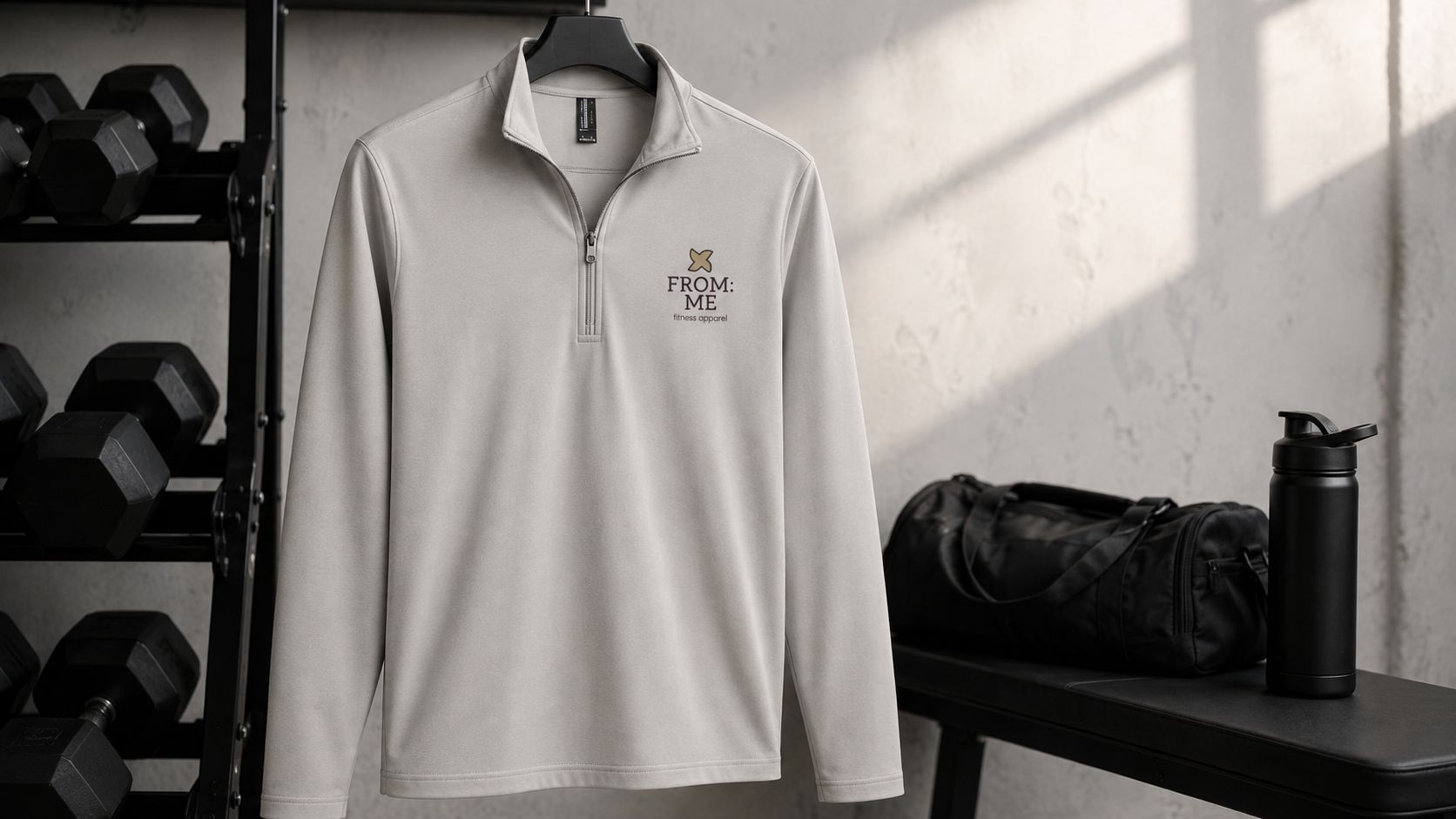
A good example of a heavier crossover layer is the Daily Standard Quarter-Zip. It uses 8.5 oz/yd², or 280 GSM, four-way stretch French terry, and a 60/35/5 cotton/polyester/spandex blend, so I'd treat it as a standard-fit warm-up or mid layer rather than a high-output summer base layer.
Before buying, read the care label and product details together. Check the fiber percentages, fabric weight if listed, stretch direction, drying instructions, and seam construction. If the label tells you the material but not how it handles sweat, assume you still need to inspect the knit and fit.
How Long Sleeves Regulate Temperature During Training
A long sleeve doesn't cool you because it wicks moisture. It cools you when the fabric moves sweat away from your skin and allows that moisture to evaporate through an air-permeable surface. It traps heat when sweat remains inside a humid microclimate between your body and the garment.
Technical literature identifies moisture-vapor resistance and air permeability as important comfort drivers in sportswear. Low vapor permeability can raise humidity next to the skin and make sweat evacuation harder. One review of heat-protection textiles reported air permeability around 700 to 1200 mm/s and moisture-management performance in the OMMC 0.5 to 0.7 range for strong thermoregulatory fabrics. A separate wear trial found that an 86% polyester and 14% elastane sportswear fabric was rated most comfortable by more than 80% of participants (textile comfort review).
Three sessions, three decisions
At 50°F, an easy run usually benefits from a thin synthetic long sleeve because your output is steady and the air can keep drawing heat away from exposed skin. A single continuous layer may feel more stable than a short sleeve with separate arm warmers, especially if the warmers shift or leave a gap at the upper arm.
At 75°F, intensity changes the equation. During a tempo session, a loose or close-fitting long sleeve with mesh panels can outperform a dense compression layer because air can enter and moisture can leave more easily. The issue isn't sleeve length by itself. It's the combination of knit openness, garment fit, color, and the amount of sweat your pace produces.
At 85°F, direct sun can justify long sleeves during a lifting session, particularly if you're training outdoors or moving between shaded and exposed areas. You may feel warmer than you would in a tank, especially in a dark, tightly fitted top, but coverage can be the better trade when sun exposure is the main concern. The garment should be lightweight, breathable, and loose enough to avoid sealing a humid layer against your torso.
The scientific trade-off is clear. Sun protection and heat management can support different choices, so judge the top by airflow, surface evaporation, and session intensity, not by the promise of “cooling” alone. Guidance on women's moisture-wicking tops offers another practical lens for comparing fabric behavior and fit, especially when sweat control matters during active sessions (women's moisture-wicking tops).
Layering Long Sleeves Across Seasons and Sessions
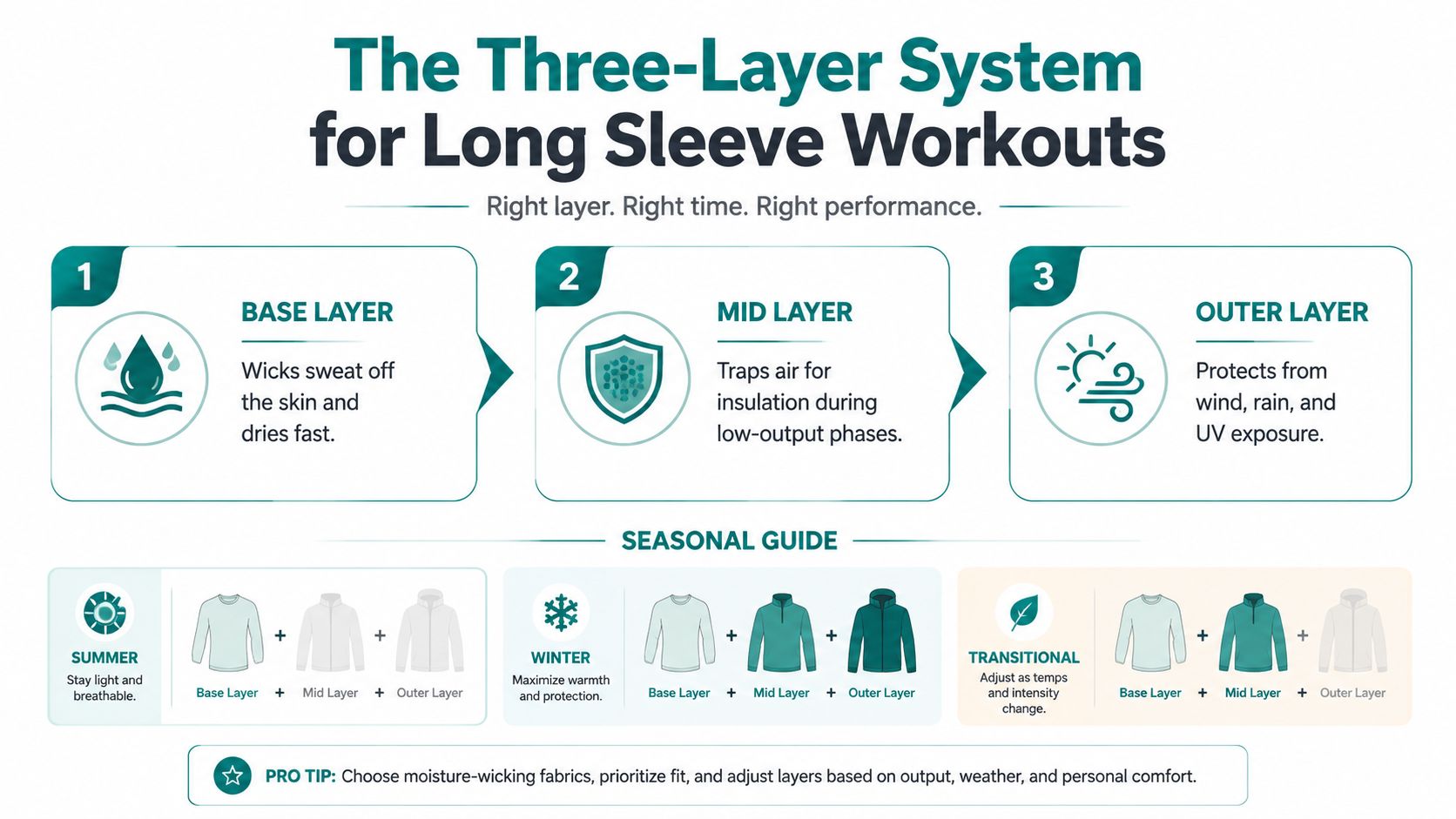
Layering works when every garment has a separate job. It fails when you stack shirts that all trap heat, absorb moisture, or restrict your shoulders.
The base layer sits next to the skin. Its job is to move sweat outward and dry without becoming heavy. For a hard run or high-repetition circuit, choose a thin synthetic or technical blend with enough stretch for your stride and arm swing.
The mid layer creates insulation by holding air. It earns its place during low-output periods, cool transitions, long easy efforts, and breaks between sets. A French terry quarter-zip or soft technical knit can work here, but it's usually too warm and dense to serve as the only layer during a hard session in mild weather.
The outer shell handles wind, sun, or light rain. It should block the elements while offering a way to release heat, such as a front zipper, vented back, or breathable panels. A shell that keeps every drop of air out may also hold sweat inside, so use it selectively.
Adjust the system to the session
- Spring: A single breathable long sleeve often handles the warm-up and the main workout. Add a shell only when wind or changing weather makes exposure uncomfortable.
- Summer dawn: Start with a light, open-knit top and carry a thin wind shell if the first part of the session is exposed. Remove the shell as effort rises.
- Autumn: Steady-state cardio may call for a base layer plus a mid layer, while short intervals often need less insulation than the walk to the start line.
- Winter: Use all three layers when wind, precipitation, and low temperatures combine. Vented panels and easy access to zippers become more important as your effort changes.
A long run, interval workout, and gym block can begin in similar conditions but create different heat loads. Dress for the hardest part of the session, then make the outer layer easy to remove. A quarter-zip can be useful between sets or during a commute, while a thin base layer remains the better choice once your breathing and sweat rate climb.
This short visual guide can reinforce the logic behind separating base, mid, and outer layers.
For a warmer crossover option, compare the structure and use case of a quarter-zip fleece layer, then ask whether it belongs next to your skin or over a lighter wicking top.
Matching Long Sleeves to Your Workout Type
The best long sleeve workout top depends on what your arms and torso do repeatedly. A top that feels excellent on a treadmill may pull across your back under a barbell, while a hiking layer can feel too loose during fast intervals.
| Workout | Recommended Cut | Fabric Weight | Key Feature |
|---|---|---|---|
| Lifting | Stretchy, close or standard fit with room at the shoulders | Light to medium | Tapered sleeves that stay clear of the wrist |
| Running | Slim athletic cut | Light | Flatlock seams and thumb loops |
| Hiking | Slightly relaxed | Light to medium | Sun coverage and a collar that works with pack straps |
| Recovery | Relaxed or drapey | Soft, light to medium | Four-way stretch and low-friction seams |
| Yoga | Close enough to stay in place, not restrictive | Light | Smooth fabric and unrestricted overhead movement |
| Athleisure crossover | Structured standard or relaxed fit | Medium | Clean hems that hold shape outside the gym |
Match the silhouette to the movement
For lifting, I prefer a stretchy knit with either raglan sleeves or generous shoulder shaping. Tapered cuffs keep fabric away from a bar, but they shouldn't squeeze when you hold a dumbbell overhead. A slightly longer torso helps during deadlifts and bent-over rows.
For running, excess fabric becomes noticeable quickly. A slim cut reduces flapping, flatlock seams reduce friction, and thumb loops help keep the sleeves in position during descents or cool conditions. Choose a thin, breathable knit for tempo work, especially if you'll stay in the top after the warm-up.
For hiking, prioritize coverage and durability around the neck and shoulders. A slightly looser fit leaves room for a pack and improves airflow, while a sun-focused construction can make more sense than compression. Hiking also rewards pockets, secure hems, and fabric that stays comfortable when your pace changes.
Recovery and yoga call for softer movement. A drapey knit with four-way stretch lets you bend, reach, and lie on a mat without the garment fighting your position. Odor resistance and easy care may matter more than aggressive wicking when sweat is light.
For gym-to-street wear, structure matters. Clean hems, a controlled shoulder line, and a fabric that doesn't collapse after a warm-up make the piece easier to wear beyond the session.
Fit, Mobility, and Sleeve Construction Details That Matter
Fit problems cause more frustration than fiber labels. A shopper may choose the right fabric and still return the top because the sleeves are short, the shoulders pull, or the hem exposes the lower back during a hinge.
Raglan sleeves run from the collar toward the underarm instead of placing a conventional seam across the shoulder. That construction can give overhead presses, pull-ups, and reaching movements more room because the shoulder seam isn't digging into the deltoid. Set-in sleeves create a cleaner, more traditional outline, but they may bind sooner when you load the upper body.
Cuffs need a firm opinion. They should stay near the wrist without pinching, rolling, or leaving a pressure mark. If you keep pushing them up during a set, the sleeve pattern or cuff tension isn't working for you.
Check the garment in the positions you train
Try these movements before removing tags:
- Reach overhead: The hem shouldn't climb sharply or pull the fabric across your chest.
- Hinge forward: Your lower back should remain covered without the torso fabric bunching under a belt.
- Rotate your trunk: The sleeves and side seams should move with you rather than twisting around the arm.
- Bend the elbow: The cuff should remain comfortable when the wrist flexes.
- Raise both arms: The underarm shouldn't feel tight or create a hard fold against the skin.
Thumb loops can stabilize sleeves during runs and layered outdoor sessions. Gusseted underarms add fabric where the arm needs to swing, while flatlock seams reduce raised edges that can rub during repeated movement. These details aren't decorations. Each one answers a specific complaint, from chafing to restricted range of motion.
Inclusive fit also requires attention to sleeve length, torso proportions, shoulder width, and the difference between compression and relaxed sizing. Don't assume a larger overall size fixes short sleeves. Compare the actual garment measurements when they're available, especially sleeve and body length.
Common Long Sleeve Workout Mistakes to Avoid
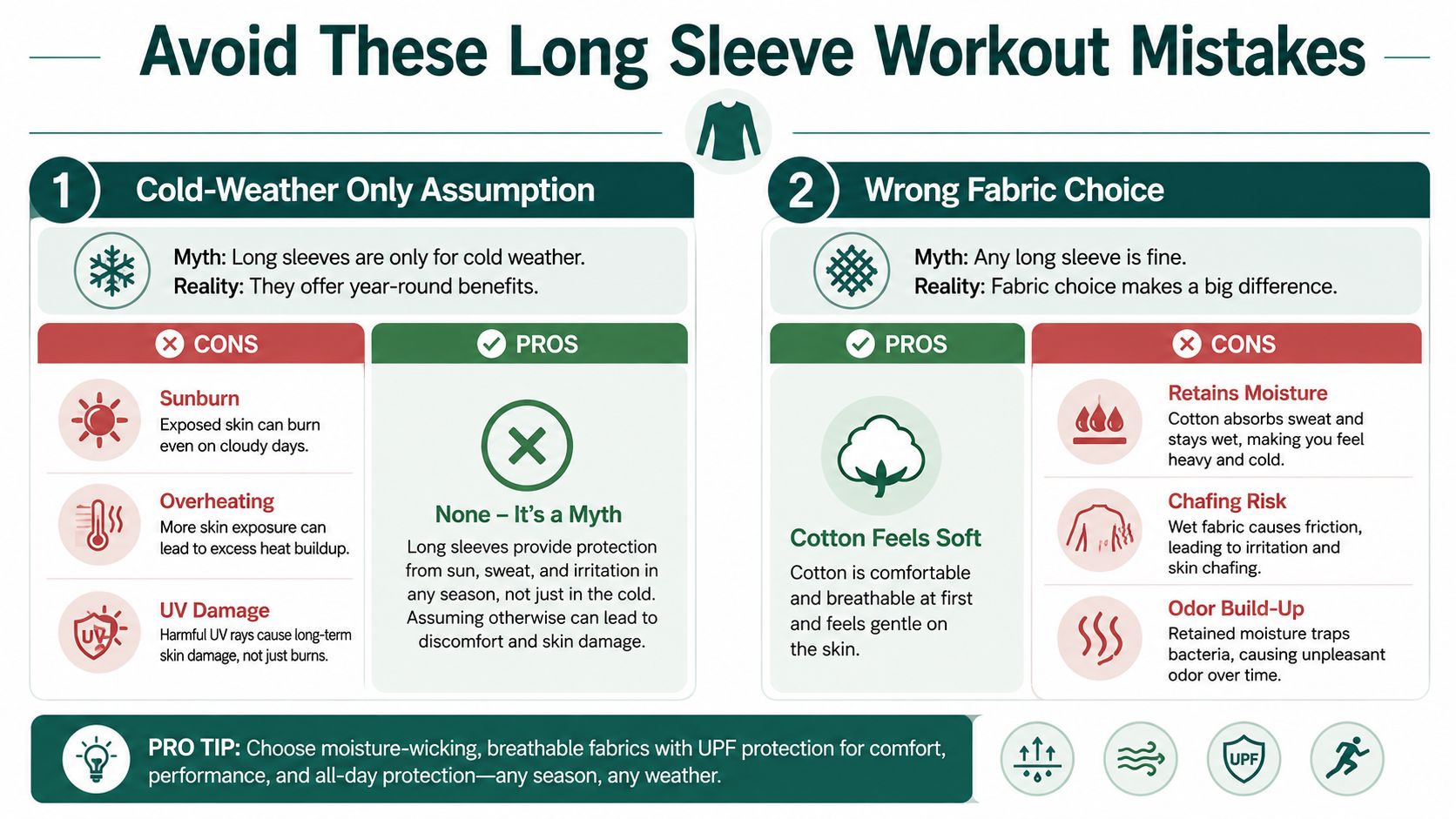
The first mistake is treating long sleeves as cold-weather-only clothing. Outdoor training exposes your arms to sun even when the air feels comfortable, and early sessions can begin cool before the workout creates heat. Air-conditioned gyms can also make a breathable long sleeve more practical than a tank during warm-ups, mobility work, or longer rests.
That doesn't mean every warm session needs extra fabric. It means you should separate sun exposure from cold exposure. A lightweight, airy top can provide coverage without behaving like an insulated layer. A dense, dark, close-fitting shirt may increase perceived heat more quickly because it limits air exchange and keeps humid fabric close to your skin.
Cotton isn't automatically a training fabric
Cotton feels soft at first contact, which explains its popularity. During high-sweat intervals or humid runs, that same absorbency can leave the shirt heavy against your skin and increase friction at the underarms, side seams, or waistband.
Cotton remains reasonable for light yoga, casual movement, warm-ups, and everyday wear. For sustained sweating, I'd rather use a synthetic knit or a technical wool blend that manages dampness in a way suited to the session. The fiber choice should follow the workload, not the softness you feel while standing still in a fitting room.
A third mistake is ignoring construction because the product page emphasizes the fabric blend. Short sleeves, tight cuffs, a narrow shoulder, or a hem that rides up can ruin an otherwise capable top. Move through your actual training positions before deciding that the fit is good.
A long sleeve workout top should disappear during movement. If you notice the cuff, seam, or hem on every set, it's not doing its job.
Your Long Sleeve Workout Buying Checklist and FAQ
Use this checklist before buying, then use it again when the seasons change. The right choice starts with the workout, not the color.
The buying checklist
- Start with climate and intensity. Choose breathable coverage for sun-exposed training, a thin wicking layer for cool starts, and a denser mid layer for low-output insulation.
- Inspect the fabric family. Synthetic blends suit high-sweat work, merino blends suit variable conditions, and cotton blends suit lighter movement or crossover wear.
- Check mobility points. Look for shoulder room, four-way stretch where needed, underarm space, a stable cuff, and enough torso length for bending.
- Match construction to the activity. Flatlock seams and thumb loops help runners, while raglan sleeves and tapered cuffs can help lifters.
- Read the care label. Wash technical tops according to the manufacturer's instructions, avoid leaving damp garments in a closed bag, and don't use harsher care than the fabric requires. Those habits help reduce odor buildup, pilling, and premature loss of stretch.
Questions athletes ask
When should I switch from short sleeves to long sleeves?
Switch when sun exposure, cool air, wind, skin coverage, or warm-up comfort matters more than maximum ventilation. If the session is hot and intense, choose an open, lightweight knit rather than a dense layer.
Is merino worth choosing?
It can be worthwhile when you move between conditions, want a softer natural hand-feel, or need a layer that works across training and travel. For very sweaty sessions, compare its drying behavior with a thin synthetic knit.
How can I stop technical tops from smelling?
Don't leave them damp and compressed after training. Follow the care label, wash them promptly when possible, and let them dry fully before storage.
Will compression sleeves outperform loose fits for lifting?
Not automatically. Compression can feel secure and reduce fabric movement, but a close fit may retain more heat or restrict movement if the pattern is poor. Choose the fit that lets you press, pull, hinge, and rotate without distraction.
What should I wear for an outdoor session in changing weather?
Use a wicking base, add a mid layer only when output or conditions justify it, and carry an outer shell when wind or light rain could change your comfort. The easiest layer to remove is often the one that saves the workout.
Build your rotation around the sessions you do, from breathable long sleeves for outdoor runs to flexible layers for lifting and warm-ups. Visit From: Me Fitness Apparel to explore fitness apparel and athleisure pieces that can support your training-to-everyday wardrobe, then compare each item by fabric, fit, and layering role before you buy.