

You're staring at an Alo Yoga set that looks perfect in a studio mirror, then wondering whether the leggings justify the price once they're used for actual training, travel, errands, and repeat washing. That search for brands like Alo Yoga usually isn't about finding an identical logo. It's about finding the right mix of polished styling, dependable fabric, flattering fit, and a price that makes sense for how you'll wear it.
Alo has a clear strength, premium studio-to-street presentation, especially in leggings and coordinated sets. But it isn't automatically the best choice for heavy sweating, men's training, inclusive sizing, or value basics. The smarter move is to match the alternative to your use case instead of buying another brand's version of the same silhouette.
| Shopper priority | Best starting point | Why it fits |
|---|---|---|
| Studio polish | Lululemon or Year of Ours | Elevated styling with strong leggings and set-based assortments |
| High-output training | Nike, Under Armour, or From: Me Fitness Apparel | More emphasis on sweat management and durable construction |
| Men's athleisure | Vuori or Rhone | Relaxed athletic cuts with a lifestyle finish |
| Value basics | Old Navy Active or Target All in Motion | Accessible everyday pieces without premium branding |
| Lower-impact materials | Girlfriend Collective or Pangaia | Stronger sustainability focus, but verify each product's details |
Table of Contents
- What Shoppers Really Mean by Brands Like Alo Yoga
- How Alo Yoga Built Its Premium Athleisure Identity
- The Main Categories of Alo Yoga Alternatives Worth Knowing
- Comparing Fabrics Fit and Sizing Across Athleisure Brands
- Where From Me Fitness Apparel Fits in the Alo Yoga Comparison
- Matching Athleisure Brands to Real Shopping Scenarios
- Choosing the Right Alo Alternative for Your Priorities
What Shoppers Really Mean by Brands Like Alo Yoga
The phrase “brands like Alo Yoga” hides several different shopping missions. Treating them as one search creates bad recommendations because a person looking for a polished Pilates outfit has different requirements from someone replacing a training wardrobe.
Three searches inside one phrase
The first shopper is the studio stylist. She wants a coordinated set, a sculpted silhouette, clean branding, and clothing that can move from class to coffee without looking like basic gym gear. For this buyer, visual finish matters almost as much as technical performance.
The second is the legging loyalist. She's chasing a high-rise waistband, a smooth second-skin feel, and a controlled, sculpting fit. She may care less about celebrity visibility and more about whether the waistband stays flat during movement and whether the fabric remains opaque in a squat.
The third is the price-aware buyer. She likes Alo's neutral colors, cropped tops, and sleek proportions, but wants comparable casual pieces without paying premium lifestyle pricing. This shopper should compare fabric composition and construction rather than assume a higher price means better performance.
Use four pillars to assess every alternative:
- Style: Does the product deliver studio polish, streetwear energy, or strictly technical athletic design?
- Fabric: Look for fiber content, stretch, drying behavior, ventilation, and hand-feel.
- Fit: Check waistband height, torso length, compression, gussets, seam placement, and size consistency.
- Price-to-value: Ask whether the garment's construction and frequency of wear justify its cost.
Sustainability is the tiebreaker, not a substitute for fit. A recycled fabric won't rescue leggings that roll down, and a made-to-order model may reduce overproduction while requiring more patience before delivery.
The market context is large enough to support sharply different alternatives. The global athleisure category was valued at USD 422.0 billion in 2025 and is projected to reach USD 892.5 billion by 2033, with a projected 9.9% CAGR from 2026 to 2033, according to Grand View Research's athleisure market analysis. Yoga apparel is also forecast to grow at 11.6% CAGR from 2026 to 2033, according to the market discussion cited by Apartstyle's comparison of brands like Alo.
That growth supports a more useful buying framework: premium studio labels, performance-first brands, men's athleisure, and affordable basics each solve a different version of the same problem.
How Alo Yoga Built Its Premium Athleisure Identity
Alo Yoga's appeal comes from the way it packages activewear as an entire lifestyle rather than a single technical product. Founded in 2007 in Los Angeles, California, by Danny Harris and Marco DeGeorge, the brand emerged during the rise of premium athleisure, social media styling, and clothing designed to move between workouts and daily life, as documented in the Alo Yoga background overview.
The four assets Alo controls
First, Alo owns a fashion-first visual language. Its photography, neutral palettes, fitted sets, oversized layers, and carefully styled campaigns make the clothing feel editorial rather than merely functional. That presentation creates desire before a shopper evaluates the fabric.
Second, Alo has built a legging-led assortment around recognizable fabric families such as Airlift, Airbrush, and Alosoft. These names help customers shop by sensation and intended use, although shoppers should still inspect the actual fiber content and care instructions on each product.
Third, visibility from celebrities, instructors, and social-media personalities turns the product into a social signal. That kind of visibility doesn't automatically prove better durability or thermoregulation. It does make the outfit easier to recognize, which matters to buyers who want brand identity as part of the purchase.
Fourth, Alo's stores and retail presentation reinforce the premium experience. The shopper isn't only paying for a pair of leggings. She's paying for coordinated merchandising, a recognizable aesthetic, and the convenience of building an entire outfit inside one visual world.
The price architecture reflects that positioning. Alo's leggings commonly sit in the $88 to $128 range, while tops and outerwear occupy their own premium tiers, according to the pricing benchmark supplied for this comparison. That premium can make sense for shoppers who wear the pieces frequently and value the finish, but it becomes harder to defend when the garment is used casually or when a technical training alternative offers more relevant construction.
Sustainability and transparency deserve scrutiny. Public criticism has focused on fabric sourcing and labor practices, so shoppers who care about responsible production shouldn't infer strong standards from premium branding alone. Check product-level material information and the brand's current disclosures before treating sustainability as a reason to buy.
| Attribute | Alo Yoga Benchmark |
|---|---|
| Style | Fashion-led, studio-to-street, coordinated and highly photographed |
| Core assortment | Leggings, bras, fitted tops, joggers, hoodies, and outerwear |
| Fit | Sculpted, high-rise, body-conscious silhouettes |
| Fabric identity | Named fabric families with soft, smooth, or sculpting hand-feel |
| Price-to-value | Premium lifestyle pricing, strongest for frequent studio and everyday wear |
| Sustainability | Requires product and policy-level scrutiny rather than assumption |
Retail rule: Alo's premium is easiest to justify when you're buying an outfit and a visual identity. It's harder to justify when you only need a sweat-wicking training top.
The Main Categories of Alo Yoga Alternatives Worth Knowing
A flat list of labels doesn't help much. The right alternative depends on which part of Alo you want to replace.
Premium studio experience
Lululemon is the closest all-around competitor for shoppers who care about leggings, polished basics, and a refined studio wardrobe. It offers a more technical product conversation, particularly for shoppers comparing soft low-impact leggings with faster-drying training bottoms.
Athleta suits buyers who want refined basics with a broader emphasis on fit options and everyday activity. It's a practical choice when Alo's fashion-led presentation feels narrower than your wardrobe needs.
Year of Ours leans into recognizable studio silhouettes and fashion styling. Choose it when the outfit itself matters and you're willing to prioritize visual character over a broad performance range.
Carbon38 works for shoppers who want a curated, fashion-forward assortment and are comfortable comparing individual pieces rather than relying on one consistent house aesthetic.
Performance-driven value
Nike, Under Armour, Gymshark, and Born Primitive prioritize training functions such as movement, sweat management, support, and repeat use. They don't always offer Alo's boutique polish, but that's the point. A runner, lifter, or HIIT participant may get more value from a technical top and durable seams than from a beautifully styled studio set.
For a broader comparison of the men's and unisex athleisure space, see this guide to brands like Vuori. A product such as the Varsity Active Tee also illustrates the performance-first lane, with a relaxed athletic fit, moisture-wicking fabric, UV protection, and a made-to-order production model.
Men's athleisure
Vuori, Rhone, Ten Thousand, and Mack Weldon address a gap Alo doesn't own as strongly: men's clothing that works for training but still looks appropriate after the session. Vuori is softer and more lifestyle-oriented, while Ten Thousand is more explicitly training-focused. Rhone and Mack Weldon sit between gym utility and polished daily wear.
Everyday basics
Old Navy Active, Target All in Motion, Amazon Essentials, and CRZ Yoga target shoppers who want familiar silhouettes at accessible prices. These brands can be sensible for rotation pieces, especially tops, shorts, and casual leggings, but inspect fabric weight, waistband construction, and return terms before buying multiples.
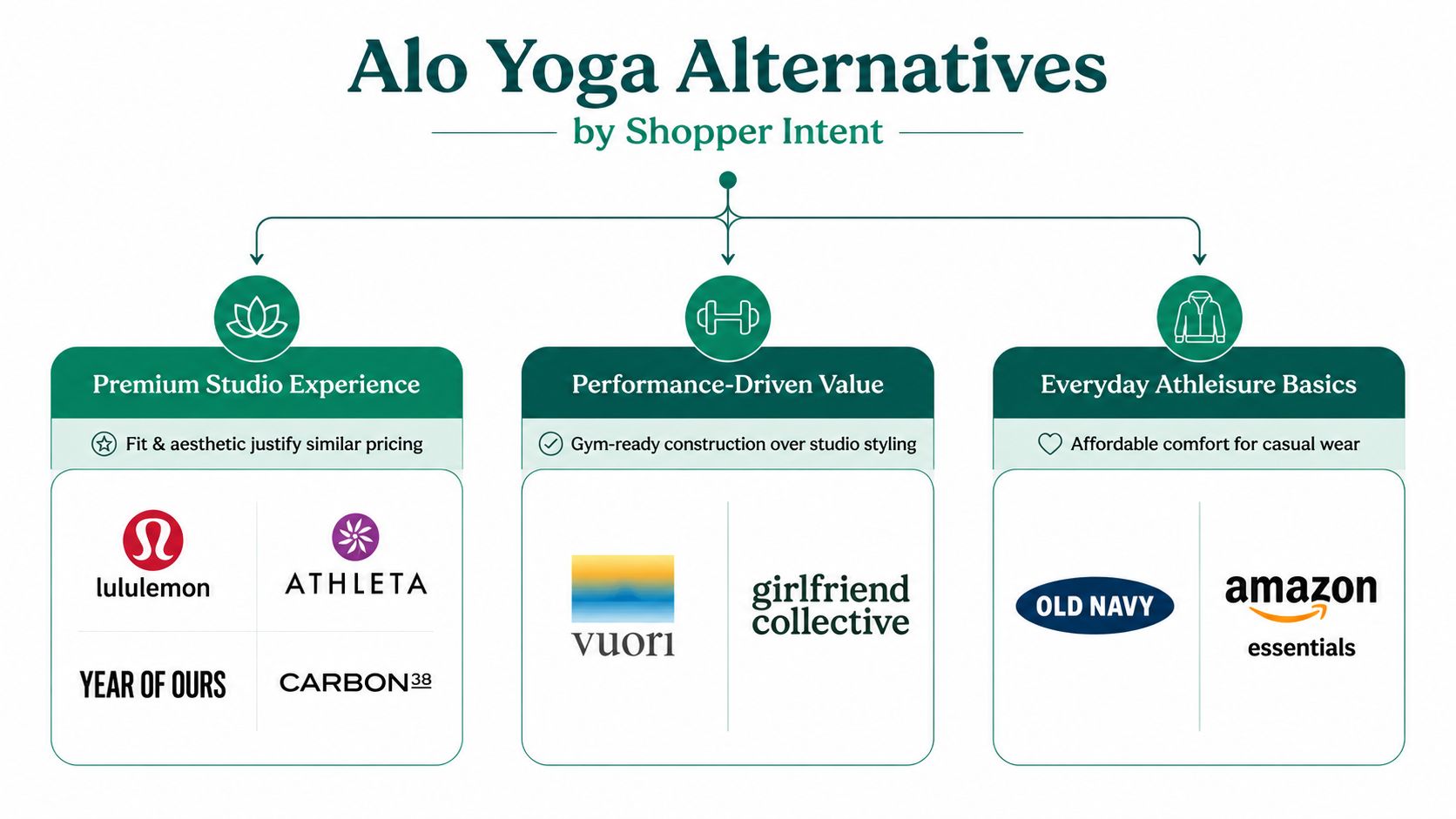
Best use of this list: Choose the category first, then compare two or three brands inside it. Don't ask a value basic to recreate a premium studio experience, or a studio label to behave like a lifting uniform.
Comparing Fabrics Fit and Sizing Across Athleisure Brands
Logos don't touch your skin. Fabric, seams, and waistband construction do.
Alo's appeal comes partly from smooth nylon-spandex and soft stretch constructions that create a sleek, held-in feel. Lululemon separates softer low-impact fabrics from more training-oriented options. Vuori generally emphasizes a brushed, comfortable hand-feel, while Athleta often balances stretch, recovery, and everyday wear.
The useful technical question is moisture movement. A 2025 sportswear fabric study recorded drying rates of 2.73 mL/h for 100% polyester, 2.62 mL/h for 91% polyester and 9% spandex, 1.67 mL/h for 95% polyester and 5% rayon, and 0.67 mL/h for 100% cotton, according to the published sportswear fabric study. Polyester-based examples therefore dried roughly four times faster than cotton in that test, which is relevant for high-sweat sessions and repeated wear.
That doesn't mean synthetic fabric wins every situation. A peer-reviewed exercise study found that a polyester shirt retained less sweat than cotton and produced significantly lower rectal temperature during the final 15 minutes of heat exercise, while an evidence review from the Sport Information Resource Centre concluded that synthetic wicking fabrics generally aren't better than cotton for thermoregulation during low-to-moderate intensity exercise, as summarized in this exercise-fabric evidence source.
Construction details that matter
Look for a gusset in leggings, flat or bonded seams, a waistband that recovers after stretching, and pockets placed where they won't interfere with movement. Compression should match the activity. A soft, flexible legging is appropriate for yoga and errands, but high-output training often benefits from stronger recovery and more secure panels.
Sizing is equally brand-specific. Alo's leggings are generally body-conscious, with a high-rise feel and a close waistband. Lululemon tends to provide detailed measurements and activity-specific fits. Vuori often feels more relaxed, while value brands can run generous and vary more between product lines.
| Brand | Primary Fabric | Compression | Sizing Note |
|---|---|---|---|
| Alo Yoga | Nylon-spandex and soft stretch constructions | Medium to sculpting | Close, body-conscious fit; check each product |
| Lululemon | Nylon-based technical and soft-touch fabrics | Low to high, depending on line | Product-specific measurements are important |
| Vuori | Brushed, soft stretch knits and performance blends | Light to medium | Relaxed athletic feel |
| Athleta | Performance blends, including recycled synthetics in some products | Light to firm | Broad activity and fit range |
| Nike | Polyester-based performance fabrics and stretch blends | Light to firm | Often generous in tops and training layers |
| From: Me Fitness Apparel | Breathable performance fabrics and training-focused tops | Relaxed athletic in tops | Use the item's standard chart and fit notes |
For a deeper look at women's training staples, consult this guide to women's fitness apparel. The takeaway is simple: fiber content predicts drying behavior more reliably than the brand name, while fit and construction determine whether the garment stays comfortable under movement.
Where From Me Fitness Apparel Fits in the Alo Yoga Comparison
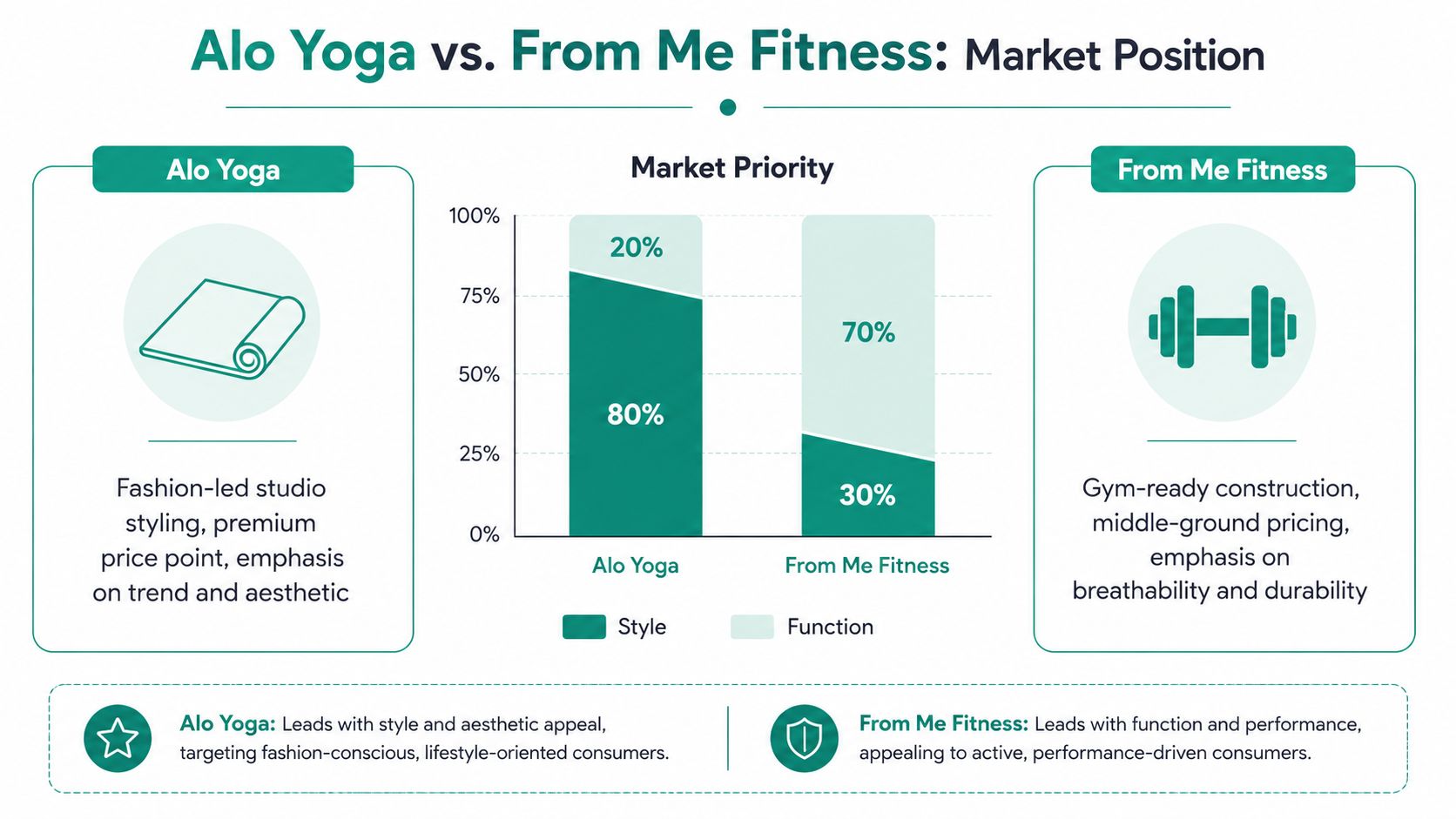
From: Me Fitness Apparel sits on the functional side of the Alo-adjacent market. It isn't trying to recreate a celebrity-led studio wardrobe, and shoppers shouldn't expect the same emphasis on coordinated fashion drops, lounge-heavy styling, or flagship-store atmosphere.
The distinction is useful. From: Me focuses on gym-ready tops and athleisure pieces with a clean, training-oriented identity. Its performance tops use breathable materials intended for movement, while its catalog also includes graphic tees, hoodies, sweaters, outerwear, shorts, and accessories for people who want training clothes that can continue into daily wear.
Style versus function
Alo's visual proposition is polished studio fashion. From: Me uses a more direct fitness language, including motivation-focused graphics and relaxed athletic shapes. The difference is obvious in the intended styling: Alo works naturally as a coordinated class set, while From: Me fits a gym rotation built around tees, layers, and practical training pieces.
Construction follows the same priority. Flatlocked seams are less visually prominent than bonded seams, but they're a sensible choice for repeated squatting, deadlifting, and general gym use. This is a functional trade-off, not a defect.
Who should consider it
From: Me is a stronger fit for shoppers who want straightforward training apparel, unisex or men's options, and a less fashion-dependent wardrobe. The catalog snapshot includes sizing through 3X for the Varsity Active Tee, with a relaxed athletic fit that runs true to size for a classic shape and can be sized up for more room.
The made-to-order approach is another meaningful difference. The Varsity Active Tee is produced after ordering, with an expected 10 to 14 day order-to-delivery window, which the product information presents as a way to reduce overproduction and textile waste. That model trades immediate fulfillment for a more deliberate production process.
Fit verdict: Choose Alo when you want sculpted studio styling. Choose From: Me when you want training tops and layers that read as gym apparel first, without the full lifestyle markup and presentation.
The brand's own story of From: Me Fitness Apparel gives more context on its training-centered identity. It's a different proposition from Alo, and that's precisely why it can work as an alternative rather than a lookalike.
Matching Athleisure Brands to Real Shopping Scenarios
The best replacement changes with the calendar. A studio class, a lifting session, an airport day, and an event weekend don't demand the same garment.
Daily studio classes
For yoga, Pilates, and low-impact studio work, prioritize waistband comfort, stretch recovery, opacity, and a finish that looks intentional outside class. Alo and Lululemon remain the strongest starting points for shoppers who want premium studio polish. Year of Ours and Beyond Yoga suit buyers who want more fashion personality or a notably soft hand-feel.
Don't overpay for high-output features you won't use. If your sessions are gentle and your main requirement is a flattering set that survives coffee afterward, style and comfort deserve more weight than aggressive sweat technology.
Gym training and HIIT
Training changes the decision. Choose Nike, Under Armour, Gymshark, or From: Me when sweat, range of motion, and seam durability matter more than a boutique appearance. Polyester-based fabrics can dry faster than cotton under the conditions tested in the fabric study cited earlier, but actual comfort still depends on ventilation, garment structure, and intensity.
For lifting, check whether leggings include a gusset and whether the waistband stays anchored during hinges and squats. For running or HIIT, inspect reflective details, pocket placement, chafe-prone seams, and whether the top clings when wet.
Men's athleisure
Alo isn't the most natural first stop for men seeking a complete training-to-lifestyle wardrobe. Vuori offers soft, relaxed pieces with a California-inspired finish, while Rhone and Mack Weldon suit shoppers who want more polished everyday silhouettes. Ten Thousand belongs on the shortlist when the priority is hard training rather than lounge comfort.
Travel and event weekends
Travel calls for layers that don't make every outfit look like gymwear. Athleta and Spanx are useful places to look for commuter-friendly pieces, while Vuori works when softness and casual versatility lead.
Event weekends are different. Alo, Year of Ours, Beach Riot, and fashion-forward capsule labels are better when the outfit needs visual impact. Prints, coordinated colors, and distinctive cuts matter more than maximal technical performance.
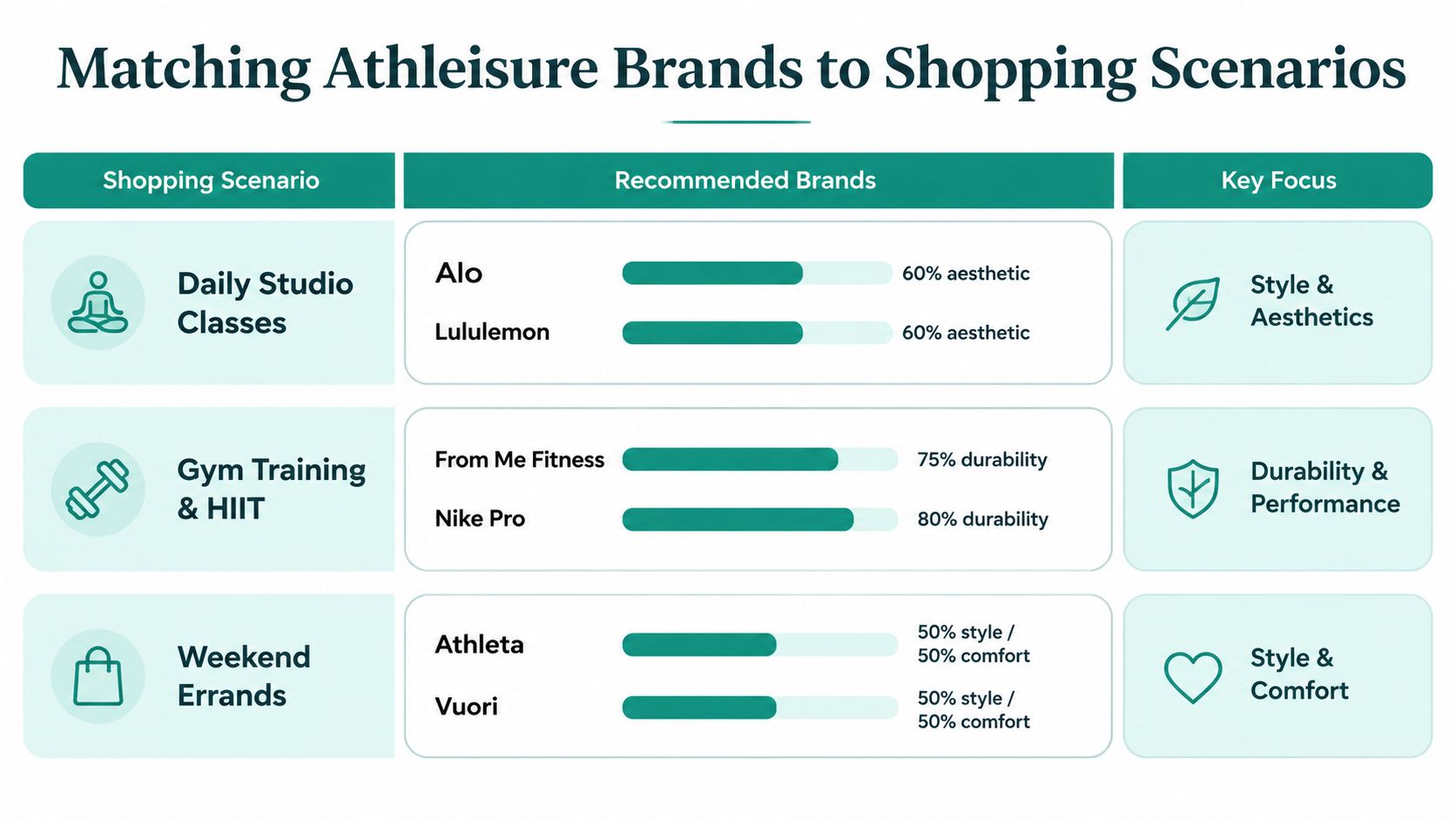
A two- or three-brand rotation usually beats forcing one label to cover every workout and every social setting.
Choosing the Right Alo Alternative for Your Priorities
Don't choose the brand with the most convincing campaign. Choose the one that solves your most frequent problem.
If studio polish comes first
Start with Lululemon for a polished, technically broad wardrobe. Choose Year of Ours if you want more distinctive styling and a set-led look. Alo remains appropriate when brand recognition and a fashion-led silhouette are part of the experience you're buying.
If sweat-heavy training is the priority
Choose Nike or Under Armour for established performance systems, especially when you need training tops, running layers, and support across multiple activities. Vuori is a better compromise if you want technical comfort with a softer lifestyle finish.
If value matters most
Build around Champion, Old Navy Active, Target All in Motion, or similar basics. Use them for tees, shorts, and rotation pieces, then spend more selectively on the garment where fit matters most, often a bra or a pair of leggings.
If sustainability is non-negotiable
Look at Girlfriend Collective, Pangaia, or Threads 4 Thought, then verify the material and production information for the exact product. The broader market discussion identifies organic cotton, bamboo, and recycled polyester as materials increasingly considered by shoppers, but a fiber label alone doesn't tell the full environmental story.
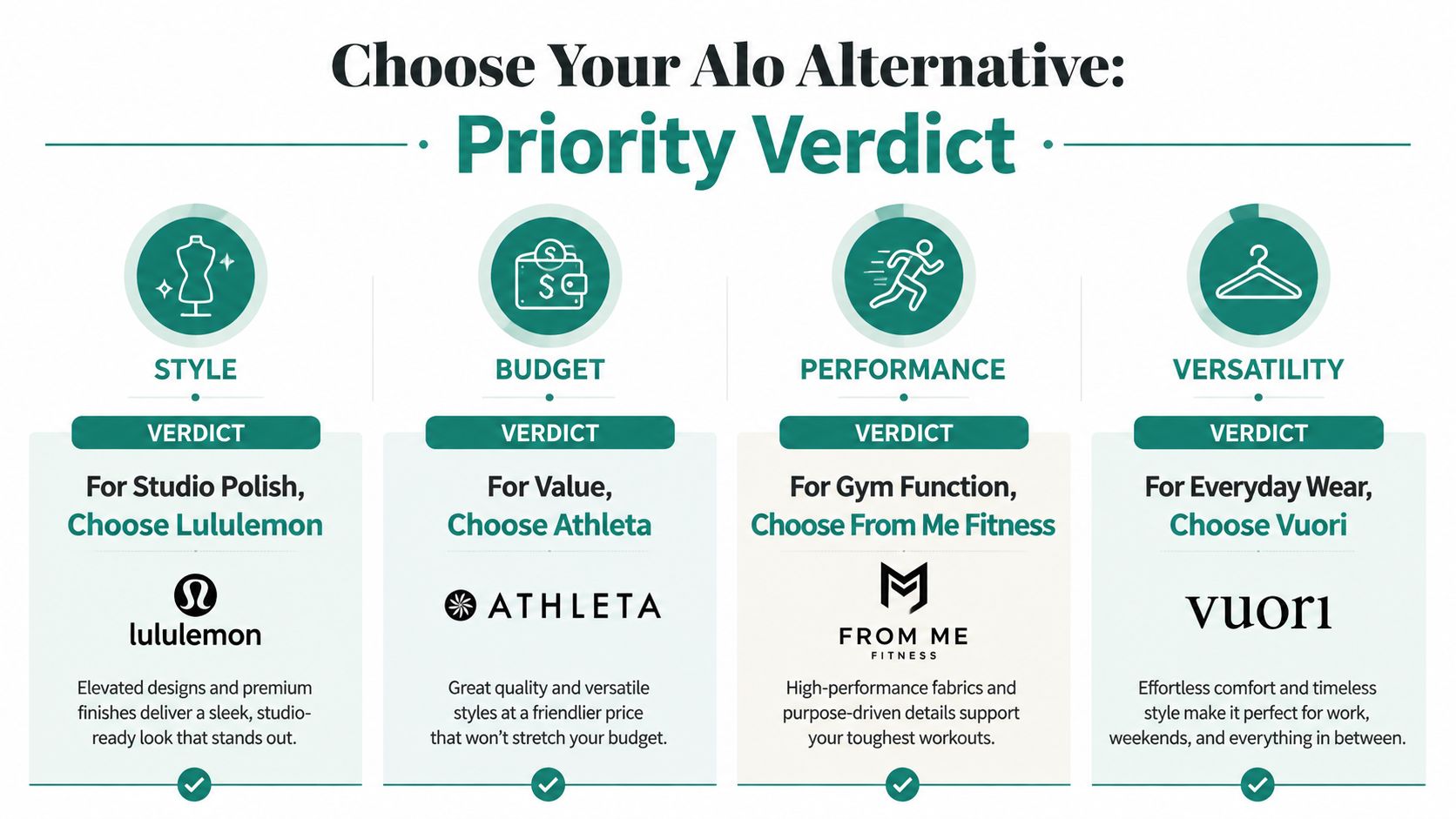
Use this quick checklist before buying a full set:
- Rank one priority: Decide whether style, sweat management, value, fit, or materials matters most.
- Set a budget ceiling: Don't let a coordinated look push you into paying for features you won't use.
- Test one piece: Wear and wash a single item before committing to a complete wardrobe.
- Check the use case: Studio leggings, lifting shorts, travel layers, and everyday tees should not all be judged by the same standard.
No single label owns every category Alo touches. Alo is strong at premium visual identity and legging-led studio dressing, while other brands win on technical training, men's cuts, inclusive options, value, or production choices.
From: Me Fitness Apparel offers performance tees, graphic training tops, shorts, hoodies, and layers for shoppers who want gym-ready clothing with a straightforward athletic identity. If you'd rather build your Alo alternative around training function and everyday wear, visit From: Me Fitness Apparel and compare the pieces against your actual workout routine.