

You're heading out for a chilly coffee run after the gym, and a beanie feels too tight, too warm, or too predictable. A sherpa bucket hat offers another answer: soft insulation around the crown and ears, a relaxed brim, and enough streetwear character to make a simple hoodie-and-joggers outfit feel intentional.
Think of it as cozy armor. A sherpa bucket hat isn't only a fluffy winter accessory. It's a cold-weather adaptation of a silhouette that was originally valued for utility, weather resistance, and portability.
This guide breaks down how the hat is built, why it feels warm, where it loses breathability, and how brim shape affects shade without guaranteeing certified sun protection. You'll also learn how to check the fit, style it with athleisure, and care for the pile so it stays soft instead of becoming a flattened patch on top of your head.
Table of Contents
- Introduction to the Sherpa Bucket Hat Trend
- What a Sherpa Bucket Hat Is and How It Works
- Materials Construction and Warmth Explained
- Pros and Cons You Should Weigh Before Buying
- How to Find Your Fit and Style It With Athleisure
- Care Instructions That Keep Sherpa Fluffy Longer
- Building Your Athleisure Wardrobe Around Your New Hat
Introduction to the Sherpa Bucket Hat Trend
A sherpa bucket hat works especially well for the in-between moments of the day. You might wear it on a brisk walk, while traveling between errands, or after a workout when you want warmth but don't need a full winter cap. The downward brim gives the look more structure than a beanie, while the plush surface adds visual softness to athletic basics.
The appeal also comes from the hat's unusual balance. It looks tactile and relaxed, yet the bucket shape has a practical history. The silhouette traces back to early 20th-century Ireland, where farmers and fishermen used versions made from wool felt or tweed for rain protection. Raw wool's lanolin also gave those traditional hats natural water resistance, according to the documented history of the bucket hat.
From there, the form traveled through countrywear, military clothing, and streetwear. Its later association with the U.S. Army during the Vietnam War, followed by its visibility in 1980s and 1990s streetwear, helps explain why the shape still moves comfortably between practical clothing and fashion.

Sherpa versions make sense within that history. They keep the portable, all-around-brim silhouette but swap traditional weatherproof textiles for a fluffy cold-weather surface. The result suits shoppers who want a cozy accessory that can finish an outfit without looking like technical expedition gear.
The category has enough commercial staying power to support multiple materials and seasonal variations. Market estimates place the global bucket hats market at USD 400 million in 2025, with a projection of USD 660 million by 2034, while another estimate places it at USD 1.12 billion in 2025 and projects USD 1.85 billion by 2034. Those estimates differ, but both point to an established category rather than a one-season novelty, as reported by Fortune Business Insights' bucket hats market overview.
What a Sherpa Bucket Hat Is and How It Works
Start with the silhouette. A bucket hat has a rounded crown and a brim that slopes downward around the head. Unlike a baseball cap, it doesn't rely on a front visor. Unlike a close-fitting beanie, it creates a little space above the hair and can shade the face from several directions.
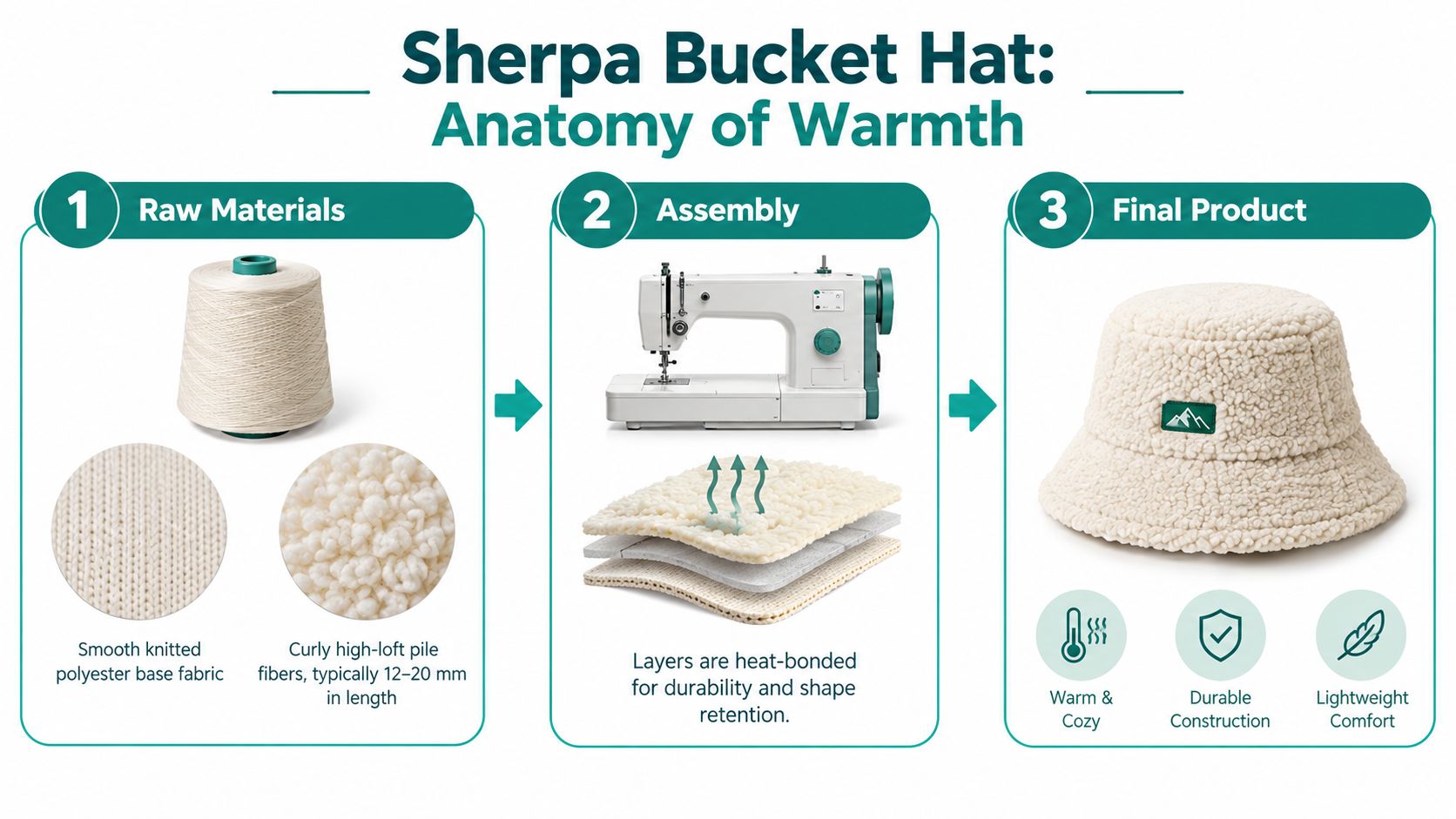
Now add sherpa. Picture a soft blanket bonded to a smooth knitted base. The base gives the hat stability, while the curly pile creates the fuzzy hand-feel people associate with sherpa fleece. The material is generally polyester, and its surface looks more cloud-like than the flatter, brushed finish of polar fleece.
That construction has a simple thermal effect. The curly fibers stand away from the base and create loft, much like the air pockets in a quilt. More loft means more trapped air, and trapped air slows the movement of warmth away from your head. A sherpa bucket hat therefore feels plush before it even feels technically warm, because your skin notices softness and bulk immediately.
How the parts affect daily wear
- The crown provides the main insulation and determines how much of your head feels enclosed.
- The brim adds visual structure and can extend shade around the face.
- The pile creates softness, warmth, and the textured look that distinguishes sherpa from smooth fleece.
- The inner construction affects whether the hat feels stable, slippery, breathable, or bulky.
Sherpa sits between streetwear, outdoor casual, and athleisure. It can soften a heavyweight sweatshirt, echo the texture of a fleece jacket, or add contrast to sleek leggings and running shoes. The hat doesn't need to match every fabric exactly. In fact, the outfit usually looks more considered when the sherpa texture is the only visibly fluffy element.
For comparison, a lightweight nylon bucket hat uses a very different logic. The Daily Standard Nylon Bucket Hat has a reinforced stitched brim, side eyelets, a quick-dry finish, and stated UPF 50 sun protection. It's designed around airflow and weather exposure, while a sherpa version is designed primarily around warmth and tactile comfort.
A short visual explanation can help you see how the crown, brim, and pile work together:
Materials Construction and Warmth Explained
Sherpa's warmth comes from loft, not from the fact that the fabric feels thick alone. A typical sherpa fleece structure combines a smooth knitted polyester base with a curly, high-loft pile. The pile commonly uses fibers in the 12–20 mm range, and those fibers create extra air space between the surface and the base, as described in Starke Fabric's fleece material comparison.
A useful comparison is available at similar surface weight. In the cited material data, 300 GSM sherpa fleece measures about 1.1 CLO, while 300 GSM polar fleece measures roughly 0.8 CLO. CLO is a measure of thermal insulation, so the comparison suggests that sherpa's taller, bulkier pile can retain more heat than flatter polar fleece at the same stated GSM.
That advantage matters in a hat because the fabric sits close to sensitive areas. The crown warms the top and sides of the head, while a low enough brim can help cover the upper ears. You'll notice the benefit most during a quiet walk, a commute, or a travel day when you aren't producing much body heat through movement.
Why warmth can reduce comfort during activity
The same loft that traps warm air can also slow heat release. Sherpa tends to feel less breathable than a lighter, smoother fabric, so it may become uncomfortable during running, intense circuits, or extended high-output training. That doesn't make it a poor hat. It places the hat in a clearer category.
| Wearing situation | Likely sherpa experience |
|---|---|
| Cold, low-wind walk | Warm and comfortable |
| Coffee run or travel day | Cozy, with strong outfit appeal |
| Post-workout errand | Useful once your activity has ended |
| High-output training | May feel too warm without ventilation |
| Transitional weather | Depends on pile weight and lining |
Designers can reduce the problem with ventilation or a lighter GSM lining, but shoppers shouldn't assume every sherpa bucket hat has those features. Check the interior, look for eyelets or mesh panels, and treat fabric weight as part of the buying decision rather than a minor detail.
Pros and Cons You Should Weigh Before Buying
A sherpa bucket hat makes sense when a beanie feels too close-fitting but the weather still calls for warmth. Its pile feels soft against the head, while the brim gives an outfit a clear outline. With a fleece jacket, oversized sweatshirt, and relaxed sneakers, it works as a cold-weather utility version of a historically weatherproof silhouette, rather than a novelty texture added for decoration.
The tradeoffs are practical. Plush pile can hold excess heat, occupy more space in a bag, and pill or shed where it rubs against straps and coats. A broad brim can also lose its shape if the hat is crushed under heavier items.
The decision in plain language
Choose sherpa when:
- Warmth is the priority. It suits cool walks, travel, commutes, and errands where you are not generating much body heat.
- Texture matters to your outfit. The pile creates a cozy focal point against smooth jersey, nylon, denim, or cotton.
- You prefer relaxed headwear. A bucket crown generally gives more room than a fitted beanie.
- You want a transitional accessory. It can fill the gap between a light cap and a heavy winter hat.
Choose something lighter when:
- You're exercising at high output. Breathable fabric and ventilation will usually release heat more comfortably.
- You need compact packing. Smooth nylon or thin cotton takes less room and handles compression more easily.
- Sun protection is the main goal. Sherpa's thickness may create shade, yet thickness alone does not confirm a certified UPF rating.
Brim width, fabric density, and color all affect coverage. Explicit UPF labeling gives a clearer basis for comparison than appearance alone. The technical discussion of bucket hats and UVR protection supports checking those details before treating a hat as sun-protective gear.
Sherpa is often better suited to after-workout, travel, or lifestyle wear than all-day performance use. For a technical alternative, look for quick-dry construction, ventilation eyelets, and a stated UPF rating before you buy. The right choice depends on whether your priority is retained warmth and tactile comfort, or lighter breathability and documented coverage.
How to Find Your Fit and Style It With Athleisure
Fit starts with the circumference, not the brim. Measure around the part of your head where the hat will sit, keeping the tape level above the eyebrows and around the widest area at the back. If the hat is one-size, compare your measurement with the seller's guide rather than assuming the fluffy fabric will make a poor fit disappear.
Once the hat is on, check three points:
- The crown should sit securely without squeezing. You should be able to move your head without the hat sliding backward.
- The brim should clear your eyes. A downward angle is useful, but you shouldn't need to tilt your chin up to see.
- The ears need a personal decision. Partial coverage adds warmth, while a higher fit feels lighter and shows more of the hairstyle.
For a more precise reference, use this bucket hat size chart and compare its measurements with your own head circumference.
Outfit formulas that keep the texture balanced
A cream sherpa hat looks polished with black leggings, a charcoal hoodie, and white trainers. The light pile becomes the contrast point, while the rest of the outfit stays quiet. For a softer palette, try the same hat with oatmeal knitwear, stone joggers, and neutral sneakers.
For a streetwear direction, pair a darker sherpa hat with an oversized graphic tee, loose shorts, tall socks, and a zip hoodie. The hat's rounded crown offsets broad shoulders and relaxed layers. If the tee already has a large graphic, keep the sherpa color solid so the outfit doesn't become visually noisy.
A cropped puffer or smooth nylon jacket creates another useful contrast. The jacket reflects light and looks technical, while the sherpa adds warmth and depth around the face.
| Situation | Color direction | Pile direction |
|---|---|---|
| Cool-weather everyday wear | Cream, brown, charcoal | Fuller pile for a cozy focal point |
| Transitional spring or fall | Stone, olive, muted blue | Lower or lighter pile |
| Dark athleisure set | Cream or warm contrast | Medium pile |
| Soft neutral outfit | Tonal beige or gray | Texture-led, minimal branding |
When the temperature rises, swap sherpa for a smooth nylon bucket hat. Save the fluffy version for the walk home, the café stop, or the travel segment after training, rather than forcing it into a workout where you already know you'll overheat.
Care Instructions That Keep Sherpa Fluffy Longer
Sherpa stays attractive when you treat the pile as a surface that can mat, not as ordinary flat jersey. Friction, heat, body oils, and rough washing can pull fibers together or make loose fibers shed. Care won't stop every sign of wear, but it can slow the changes that make the hat look tired.
A gentle maintenance routine
- Check the care label first. Fiber blends and bonded layers can respond differently to washing.
- Use cold water and a gentle cycle when machine washing is allowed. Turn the hat inside out to reduce surface abrasion.
- Skip high heat. A hot dryer can flatten or distort the pile and affect the brim's shape.
- Air dry naturally. Place the hat over a clean, rounded form or reshape it by hand while damp.
- Brush the pile lightly. Use a soft clothing brush after drying, moving in the direction of the fibers rather than attacking a matted spot.
- Store it with the brim supported. Don't bury it under shoes, books, or dense clothing in a travel bag.
For a small flattened area, misting it lightly with water and easing the fibers apart with a soft brush can help. Don't yank at knots. Pulling creates more tension at the base and can increase shedding.
If the hat picks up an odor, air it out before washing. Spot cleaning is often preferable for a small mark because repeated full washes place more stress on the pile and bonded construction. You can also apply the same fabric-care mindset used for substantial fleece garments, such as the guidance associated with a heavy fleece hoodie.
Whether sherpa is worth a premium depends partly on how often you'll wear it and whether you'll maintain it. A hat that rotates through cold walks and travel earns its place more easily than one bought only for a single seasonal outfit. Made-to-order construction can also appeal to shoppers who prefer products produced after purchase, but it doesn't remove the need for careful washing and storage.
Building Your Athleisure Wardrobe Around Your New Hat
Treat the sherpa bucket hat as the texture piece in an otherwise simple system. Start with familiar foundations, such as an oversized tee, a hoodie, relaxed shorts, joggers, or clean trainers. The hat adds warmth near the face, while the rest of the outfit can stay functional and easy to repeat.
For a strong gym-to-street combination, try a dark base layer, loose shorts, a zip hoodie, and a light sherpa hat. For travel, use a tonal sweatshirt and joggers, then let the hat create contrast through texture rather than loud color. If you're building around a graphic top, the Attack The Day Heavyweight Oversized Tee uses an oversized, drop-shoulder silhouette and heavyweight garment-dyed cotton, giving the sherpa surface a substantial partner.
Before buying, ask yourself:
- Do I need warmth more than ventilation?
- Will I wear it for walks and errands, or for active training?
- Does the brim sit clear of my eyes?
- Does the pile feel manageable for my climate?
- Would a lighter nylon option serve more days?
A good hat should make getting dressed easier. Choose the sherpa bucket hat when its warmth, shape, and tactile character match the day ahead, then wear it often enough to make it part of your routine rather than a seasonal novelty.
From: Me Fitness Apparel offers fitness apparel, athleisure layers, graphic tops, shorts, and accessories that can be combined with a sherpa bucket hat for training, travel, and everyday wear. Visit From: Me Fitness Apparel to explore the collection and build an outfit that keeps your daily movement visible.