

You finish a hard set, reach for your phone, and feel your shorts sticking to your legs. The waistband has started to slide, the fabric feels heavier with every interval, and a damp liner is creating more distraction than support. You're still exercising, but part of your attention has shifted from the workout to managing your clothing.
That's why the search for moisture wicking shorts mens shouldn't end with a fabric label. The right pair combines moisture transport with a secure fit, useful stretch, sensible liner design, odor control, and construction that can survive repeated training and washing. Wicking is the foundation, but the complete short is the performance system.
Table of Contents
- The End of Sweat-Soaked Workouts
- How Moisture-Wicking Technology Actually Works
- The Best Fabrics for Wicking Performance
- Fit and Features That Boost Performance
- How to Care for Your Performance Shorts
- FAQ About Mens Moisture Wicking Shorts
The End of Sweat-Soaked Workouts
Cotton shorts can feel comfortable when you put them on. During a demanding workout, that comfort often changes. Sweat remains in the fabric, the material clings to the skin, and each movement creates more friction. Squats, lunges, treadmill intervals, and outdoor training all expose the same weakness: a fabric that absorbs moisture without moving it efficiently away from your body becomes part of the problem.
The issue isn't that cotton is always unpleasant. It's useful for relaxed wear, low-intensity activity, and recovery days where softness matters more than rapid drying. The problem comes when you expect a casual fabric to behave like technical activewear during repeated sweat cycles.
Practical rule: If your shorts feel heavier, stickier, or more restrictive as the workout continues, the garment is failing at moisture management, fit, or both.
Moisture-wicking apparel changed athletic clothing by treating sweat as a transport problem. Instead of allowing liquid to remain concentrated against the skin, engineered fibers draw it outward, spread it across the fabric, and give it a better chance to evaporate. The commercial era of this approach is often traced to the late 1980s, when synthetic performance fabrics began replacing cotton in athletic clothing. DuPont's Coolmax fiber, developed in 1986, became one of the early widely marketed moisture-managing fibers, as described in this history of wicking fabrics.
That history matters because “moisture-wicking” isn't merely a fashionable phrase. Textile standards now give manufacturers ways to evaluate absorption, liquid transfer, and drying behavior. China's GB/T 21655.2-2009 method was published on June 19, 2009, implemented on February 1, 2010, and later replaced by GB/T 21655.2-2019, published on June 4, 2019 and implemented on January 1, 2020 in the national standards record. For you, that means a good pair of training shorts should be judged by observable performance, not by the word “technical” printed on the hangtag.
How Moisture-Wicking Technology Actually Works
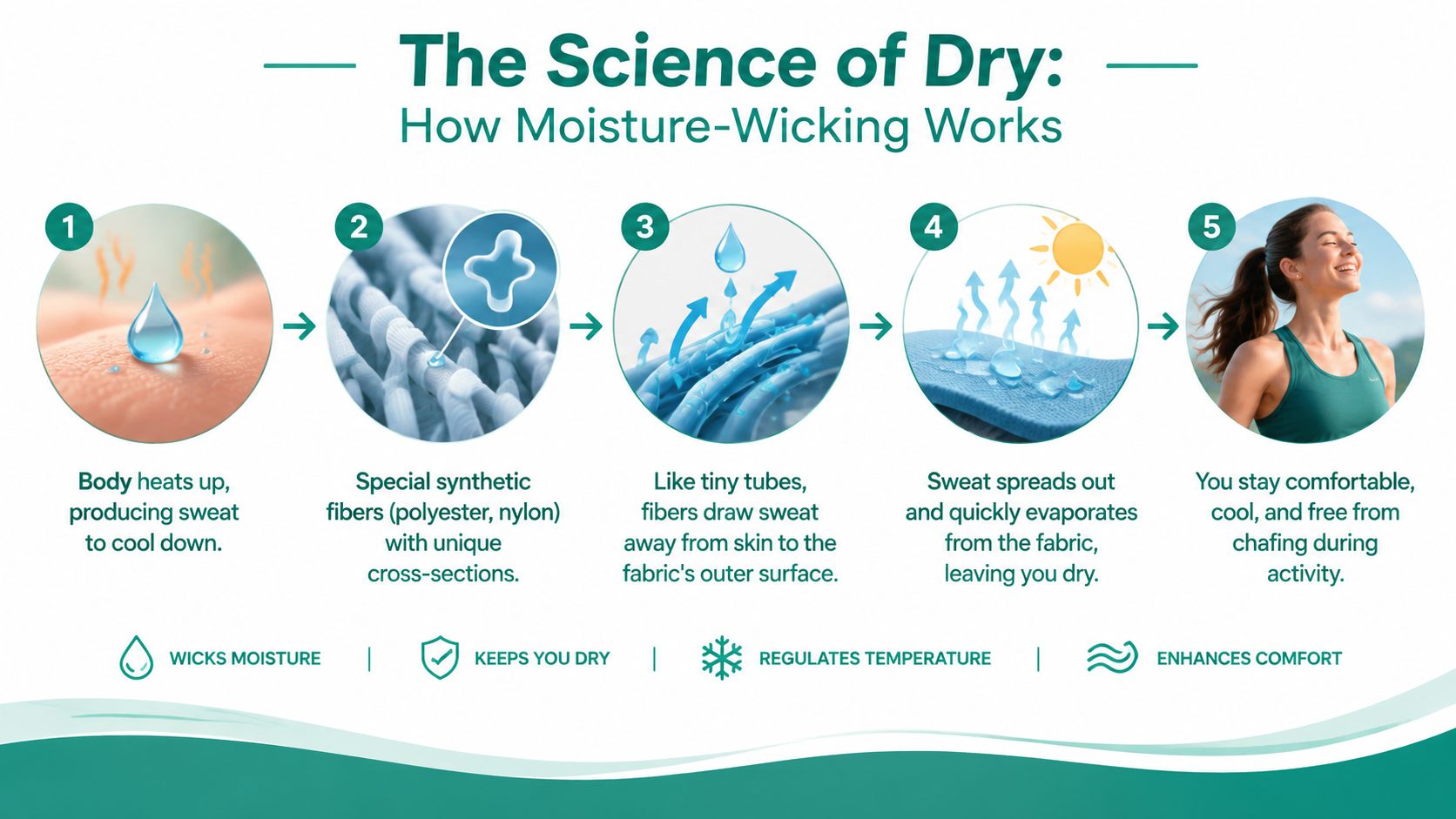
During a hard set, sweat collects where the shorts contact your skin. A well-designed performance short moves that moisture through the fabric instead of leaving a wet layer pressed against your body. The process relies on capillary action, similar to how a candle wick draws liquid through narrow spaces, but the fabric, fluid, and purpose differ. Sweat enters the inner surface, travels between fibers, and reaches the outside where evaporation can occur.
The five-part process
- Your body produces sweat. Exercise raises body heat, and evaporation helps cool you.
- The inner fabric receives moisture. The shorts need enough contact with your skin to collect sweat, while avoiding one dense, saturated patch.
- Fibers move liquid outward. Engineered synthetic fibers can form tiny channels that pull moisture away from the skin.
- The fabric spreads the sweat. A broader damp area gives air and heat more surface to remove moisture through evaporation.
- The garment feels lighter and less clingy. Wicking will not stop sweating, but it can reduce wet fabric rubbing against your body.
Fiber choice only establishes the starting point. Yarn construction, knit or woven structure, surface treatment, panel placement, liner design, and fabric weight all influence the result. A short can use a capable synthetic fiber and still feel hot or damp if its construction traps moisture or limits airflow. Anti-odor treatment, durable stitching, and a fit that stays stable during movement also determine whether that fabric performs well over repeated workouts.
What testing measures
The Moisture Management Test, or MMT, examines more than drying speed. It measures wetting time, absorption rate, maximum wetted radius, spreading speed, and one-way transport index. These results distinguish fabric that transfers liquid from the inner surface to the outer surface from fabric that absorbs sweat and remains wet, as explained in this technical discussion of moisture management testing.
Product descriptions are more useful when they specify one-way transport, low wetting time, or rapid drying. Vague terms such as “cooling” and “advanced” tell you less about workout performance. You can also assess the short during a demanding session. If the inner surface stays soaked while the outside feels relatively dry, moisture is moving poorly through the garment.
A soft cotton-polyester fleece short, such as the Women's Daily Standard Black Camo Heather Shorts, serves casual and lounge use rather than high-output training. Its relaxed fit, garment-washed finish, and fleece construction prioritize softness and everyday wear. That example helps separate comfort features from wicking performance, since a soft hand feel does not prove that a garment manages sweat effectively.
The Best Fabrics for Wicking Performance
Performance polyester is usually the safest starting point for men's moisture-wicking shorts. Polyester fibers resist absorbing water into the fiber mass, and manufacturers can engineer the yarn and fabric structure to move liquid across the garment. Standardized vertical wicking tests report polyester transporting moisture roughly 3 to 5 times faster than cotton, with typical wicking heights of 8 to 12 centimeters in 10 minutes for polyester compared with 2 to 4 centimeters for cotton under the same conditions, according to this polyester and cotton wicking comparison.
| Fabric | Wicking ability | Breathability | Durability | Best for |
|---|---|---|---|---|
| Polyester | Strong when engineered for moisture transport | Good, depending on knit and weight | Good for regular training | Gym sessions, running, repeated sweat |
| Nylon | Good quick-drying potential with a smooth hand feel | Often comfortable, depending on construction | Strong abrasion resistance | Versatile training and outdoor use |
| Spandex blends | Depends on the primary fiber | Can feel close-fitting and supportive | Stretch fibers need careful laundering | Squats, mobility work, fitted liners |
| Cotton | Holds moisture rather than moving it rapidly | Comfortable when dry, less suitable when saturated | Familiar and practical for casual wear | Low-intensity use and recovery |
Polyester versus cotton
Cotton's weakness appears after sweat accumulates. It can absorb moisture into the fabric, remain wet against the skin, and take longer to dry. Polyester can still feel clammy if the garment is poorly designed, but its hydrophobic behavior gives manufacturers a better foundation for outward moisture movement.
That doesn't make every polyester short good. A cheap, dense knit can feel hot. A rough seam can cause irritation. An untreated garment can retain odor even if it dries reasonably well. Judge the fiber alongside the fabric weight, airflow, seam placement, and liner.
For a broader look at how clothing choices affect training comfort, the men's fitness apparel guide is a useful companion when building a practical rotation.
Nylon and stretch blends
Nylon often feels smoother and can offer strong durability, but its performance depends heavily on the fabric structure and finish. It's a sensible choice for men who want a short that can handle training and everyday use without feeling overly technical.
Spandex, elastane, or another stretch fiber improves freedom of movement. It helps the garment follow your hips and thighs through split squats, deadlifts, and running strides. The trade-off is that high stretch can make a short feel warmer or more compressive, and elastic components need gentler care than a basic woven shell.
A cotton-polyester-spandex performance layer, such as the Daily Standard Quarter-Zip, illustrates why blend percentages matter. A 4-way stretch French terry can prioritize movement and comfort, but a cotton-containing construction shouldn't be confused with a dedicated high-sweat short.
Fit and Features That Boost Performance
Fabric gets most of the attention, but fit determines whether the fabric can do its job. A short that rides up exposes more skin to friction. A loose liner shifts during running. A waistband that stretches out forces you to adjust it between sets. These problems can ruin an otherwise capable moisture-management system.
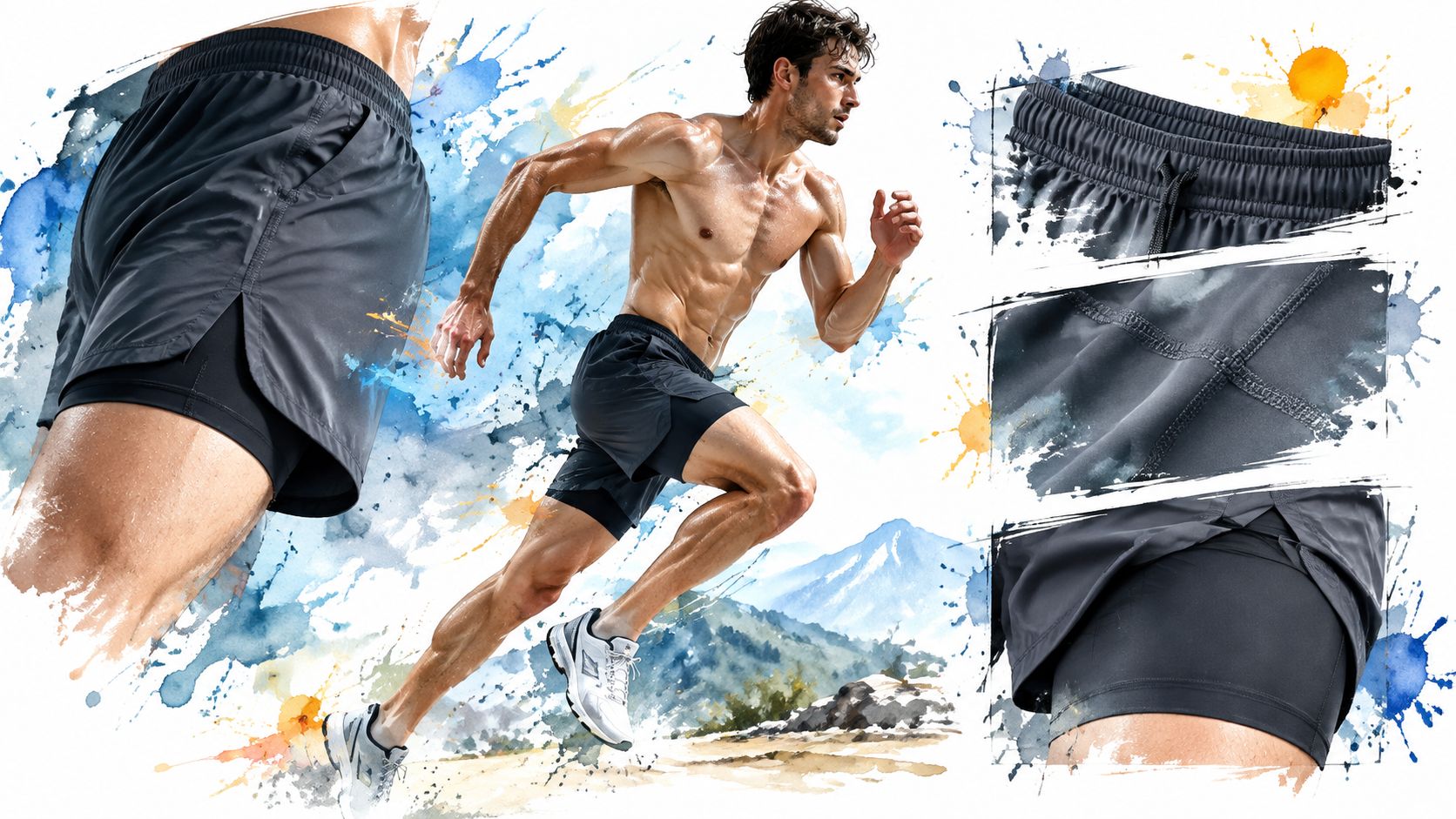
Choose the liner for the movement
A brief liner gives light coverage and can reduce the need for separate underwear. It works well when you prefer a minimal feel and unrestricted stride. A compression liner provides more coverage and may feel more stable during running, lifting, or high-movement circuits, but it can also feel warmer.
Some men prefer an unlined shell because it offers maximum versatility. That choice makes sense if you already have training underwear you trust, or if you'll use the shorts for lifting where support needs are different from running.
Match length to the activity
Shorter cuts can improve airflow and reduce material around the thighs. They're useful for running, conditioning, and hot-weather workouts where unrestricted movement matters. A longer cut can offer more coverage and may feel more natural for gym training, travel, or casual wear.
Don't choose inseam length by trend alone. Check whether the hem catches on your knee during squats, whether the liner stays covered during lunges, and whether the leg opening restricts your stride. The 7-inch inseam guide can help you think through coverage and proportion before ordering.
Treat the waistband and pockets as equipment
A good waistband should stay in place without digging into your stomach. An elastic waistband plus a drawcord gives you two levels of adjustment. The drawcord matters most when you carry a phone, keys, or another small item that adds movement to the garment.
Pockets should hold what you need without swinging against your thigh. A secure back pocket can work for a key, while side pockets are more practical for everyday use. For serious running, test pocket bounce before committing to a pair.
Reviews of performance shorts repeatedly separate wicking from the broader wearing experience. Quick drying, anti-odor treatment, stretch, and liner design can matter just as much as the initial moisture transfer, as discussed in this review of workout short performance.
Anti-odor technology deserves realistic expectations. It can help a short remain more wearable after a session, but it won't replace washing, drying, or choosing a liner that doesn't stay saturated. UPF protection can also be useful for outdoor training, though it should be treated as one garment feature rather than a substitute for complete sun protection.
How to Care for Your Performance Shorts
Technical shorts can lose their advantages when you wash them like heavy towels. Sweat, detergent residue, high heat, and friction all affect fabric texture, elastic recovery, prints, and odor-control finishes. Proper care won't turn a weak short into a strong one, but it can help a well-built garment keep its intended behavior.
Use a simple wash routine
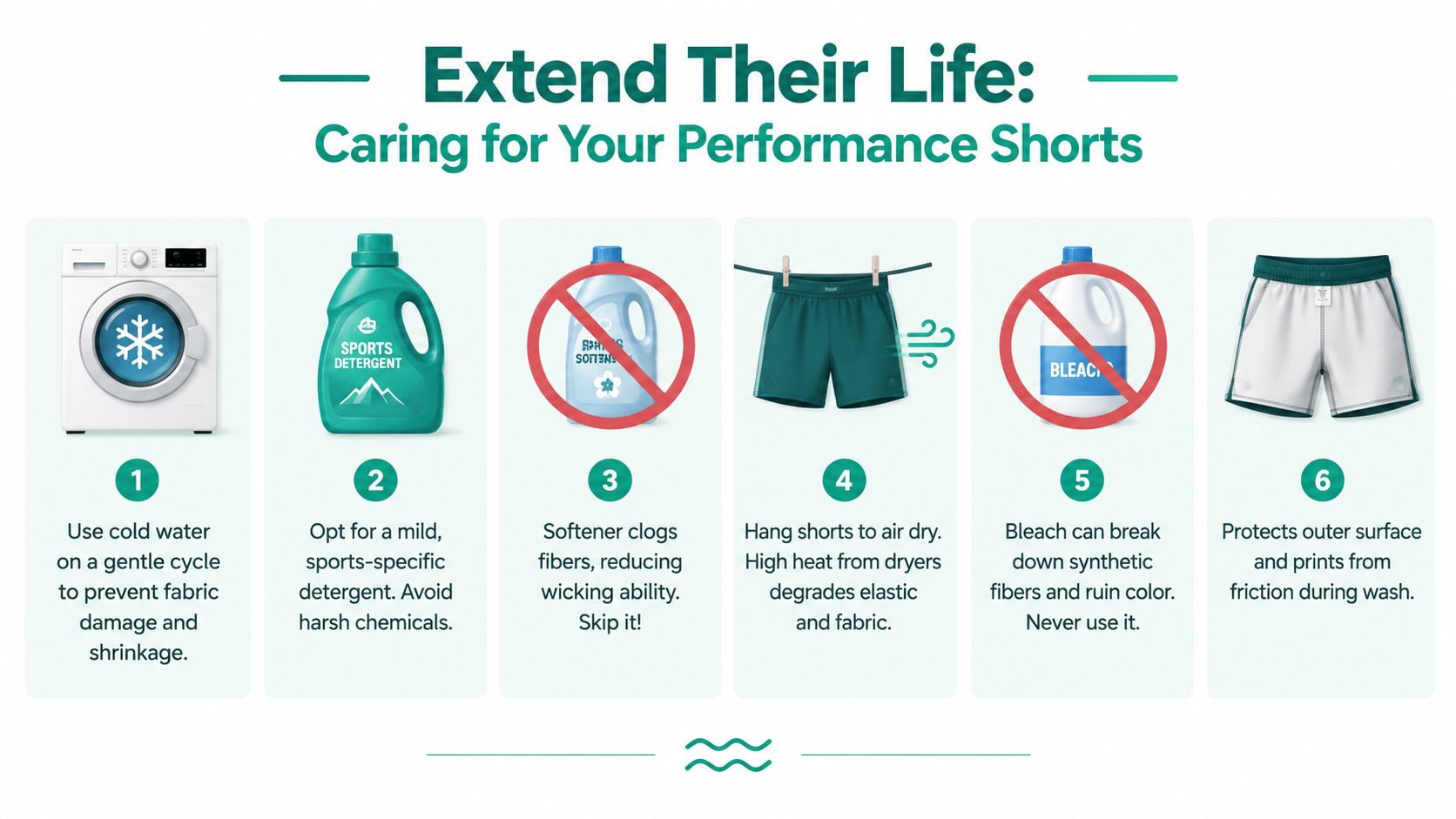
- Wash with cold water: A gentle cold cycle helps limit stress on synthetic fibers, stretch components, and color.
- Choose mild detergent: Sports-specific or mild detergent can clean sweat without relying on unnecessarily harsh chemicals.
- Skip fabric softener: Softener can coat performance fibers and interfere with the small spaces that move moisture through the fabric.
- Turn shorts inside out: This reduces friction against the outer surface, printed details, and finish.
- Avoid bleach: Bleach can weaken synthetic fibers and damage color.
- Air dry when possible: Hang drying protects elastic and avoids the stress of high dryer heat. If you use a dryer, choose a low-heat setting.
Don't leave sweaty shorts compressed in a gym bag for long periods. Moisture and trapped odor become harder to remove, especially in liners and dense waistband areas. Let the garment air out before washing, and make sure it dries fully before storing it.
Watch the details after laundering
Inspect the waistband, liner seams, crotch panel, and pocket openings. A short may still wick effectively while becoming uncomfortable because the elastic has lost recovery or a seam has become abrasive. Those construction details determine whether the garment remains useful for training, travel, and daily wear.
Long-term performance is now a practical buying concern, not a minor detail. Reviews of men's running shorts emphasize that moisture management is only one part of ownership, while construction, fit, shrinkage, and odor-treatment durability influence how a garment performs over time. The moisture-wicking fabrics market is projected to reach USD 5.02 billion by 2034, according to this running shorts testing and buying coverage. That projection makes durability worth considering, but it doesn't prove that a more expensive finish will always justify its cost.
Wash according to the care label when it conflicts with general advice. The label reflects the actual fiber blend and construction, while broad rules are only a starting point.
FAQ About Mens Moisture Wicking Shorts
Are all polyester shorts moisture-wicking?
No. Polyester is a useful base because it usually moves moisture more effectively than cotton, but yarn shape, fabric density, surface treatment, and construction affect results. Look for details such as quick drying, one-way transport, mesh panels, or moisture-management testing. A polyester label alone does not guarantee the same performance across every short.
Can I wear moisture-wicking shorts for swimming?
You can, but training shorts and swim shorts are designed for different jobs. A workout short may absorb water, lack chlorine resistance, or have a liner that feels uncomfortable when saturated. Choose swim-specific gear for the pool, and reserve training shorts for gym and running sessions.
How can I assess a pair before buying?
Check the fiber content, liner, waistband, pockets, seams, and care instructions. A product description explaining fabric construction tells you more than a simple “sweat-proof” claim. Confirm the fit before ordering by reviewing the training short size chart.
Is “quick dry” the same as “moisture-wicking”?
No. Quick dry describes how quickly fabric loses moisture. Wicking describes how well it moves liquid away from your skin and spreads it across the fabric. Moisture management includes wetting, absorption, spreading, and one-way transport, so “quick dry” alone does not describe the whole performance system. As noted earlier, these properties can be evaluated rather than treated as one advertising phrase.
What should daily trainers prioritize?
Choose the full system: dependable moisture movement, an activity-appropriate liner, a secure waistband, useful stretch, durable seams, and odor control that withstands your care routine. Anti-odor treatment can help, but it cannot compensate for poor washing or storage. A short that feels good during its first workout but becomes unpleasant after repeated laundering offers poor value.
From: Me Fitness Apparel offers men's Training Shorts with a shorter, lighter cut, an elastic waistband, a drawcord, two side pockets, and a back pocket for everyday movement. Visit From: Me Fitness Apparel to compare them with its fitness and athleisure range, then choose according to your training needs, fit, and care priorities.