

“Fast and free” combines free outbound delivery with quick transit times, usually tied to a minimum order threshold and a cutoff time for same-day processing. In U.S. apparel, the offer can still mean anything from a short standard-delivery window to a much longer made-to-order timeline, so the checkout details matter more than the banner.
You've found the leggings you wanted, added a hoodie for the trip home from the gym, and reached checkout expecting the shipping line to disappear. Instead, the cart shows a minimum spend, a countdown clock, or a delivery estimate that starts after processing. Then you notice the return policy, where “free shipping” covers only the trip to your door.
That gap between the headline and the cost is where most confusion begins. Fast and free is useful only when you understand what qualifies, when the order leaves the warehouse, how long transit takes, and what happens if the fit is wrong.
Table of Contents
- What Fast and Free Shipping Really Means
- How Eligibility and Cutoffs Shape the Offer
- The Math Behind Minimum Order Thresholds
- Comparing Standard, Expedited, and Two-Day Speeds
- Why Free Shipping Is Not Always Free Shipping
- Apparel Returns Fit and the Hidden Cost of Exchanges
- How to Verify a Fast and Free Offer at Checkout
- Smart Habits for Getting the Best U.S. Delivery Deals
What Fast and Free Shipping Really Means
Fast and free is a marketing umbrella, not one universal delivery guarantee. Retailers combine a price condition, an order-processing rule, and a carrier transit window to create the promise. The word “free” usually applies to outbound shipping, while “fast” describes the time between shipment and arrival.
Three mechanics sit underneath the offer:
- The minimum order threshold: Your cart must reach a stated subtotal before the retailer waives standard shipping. The threshold may apply before discounts, after discounts, or only to eligible merchandise.
- The daily cutoff: Orders placed before the warehouse's processing cutoff may leave sooner. Orders placed afterward can move into the next processing cycle.
- The transit window: Once the parcel ships, the carrier needs time to move it through the delivery network. That window can vary by destination, warehouse location, weekends, weather, and service level.
A checkout banner may say “fast and free,” while the actual promise ranges from two to seven business days depending on the retailer's terms and the shopper's location. That range isn't contradictory. A nearby customer may receive standard ground delivery quickly, while a distant or rural address waits longer under the same offer.
Practical rule: Treat “fast and free” as a starting label. Treat the cart's delivery date and shipping policy as the actual agreement.
The other important distinction is outbound versus return shipping. Free outbound delivery covers the cart-to-door leg. It doesn't automatically cover a return label, an exchange shipment, a restocking deduction, or the cost of sending back an item that doesn't fit.
This matters especially in apparel. General e-commerce returns were benchmarked at 16.9% in 2024 and were projected toward 19.3% in 2025, while apparel commonly falls around 23% to 30%, depending on channel and segment, according to return-shipping cost benchmarks from Opensend. The value of a shipping offer therefore depends on the entire purchase journey, not just the first delivery charge.
How Eligibility and Cutoffs Shape the Offer
Suppose you add leggings and a hoodie to your cart. The products may qualify individually, but the retailer still checks the cart subtotal, destination, item exclusions, and processing time before showing a fast-and-free option.
Start with the subtotal. If the retailer requires a qualifying minimum, your order may need to reach that amount after discounts but before taxes, or before discounts and taxes. The policy should say which calculation applies. A progress bar in the cart can help, but it's only a guide until checkout confirms eligibility.
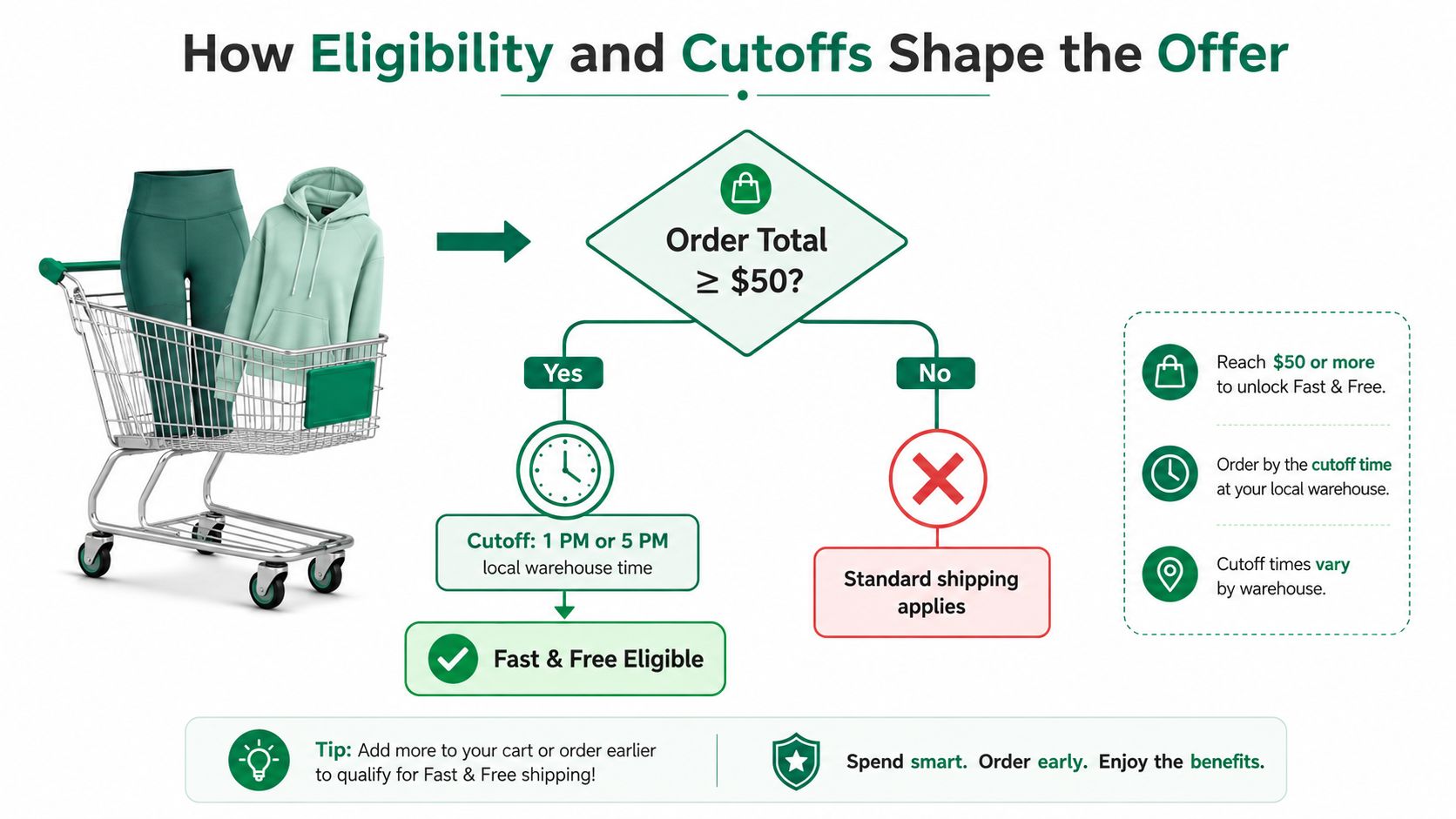
The clock starts before the carrier receives the parcel
A warehouse cutoff is the point at which the retailer stops assigning new orders to that day's processing queue. A cutoff might be displayed as 1 PM or 5 PM local warehouse time, but those times are examples of how policies are written, not a universal rule. If you order after the stated cutoff, the parcel may wait for the next business day before processing begins.
That creates two separate timelines:
- Processing time: The retailer prepares, packs, or produces your order.
- Transit time: The carrier moves the shipped parcel to your address.
A product can have free U.S. shipping and still take longer because it's made to order. For example, the Lifting Club Hoodie states that it arrives in 10–14 days, includes free U.S. shipping, and offers 14-day returns on eligible items. Its made-to-order production timeline means “free” doesn't mean immediate dispatch.
Read the address and item rules
Eligibility can differ for U.S. addresses, contiguous states, Alaska, Hawaii, territories, and military addresses. PO boxes may require a carrier that doesn't support every service level. Retailers can also exclude final-sale products, oversized merchandise, gift cards, or items shipped from a separate facility.
Guest checkout and logged-in checkout may show different offers when a retailer reserves shipping benefits for loyalty members. Before trusting the banner, confirm the destination ZIP code, item eligibility, cutoff time, processing period, and delivery estimate in the cart.
The Math Behind Minimum Order Thresholds
A free-shipping threshold is designed to make the shipping charge feel invisible while encouraging a larger basket. Retailers typically choose the threshold by balancing product margins, carrier costs, average basket behavior, and the risk that a customer returns part of the order. The shopper's job is simpler: compare the cost of adding an item with the cost of shipping without it.
Consider an activewear cart with a sports bra priced at $42 and a tank priced at $28. The subtotal is $70. If the threshold is $75, adding a third item may qualify you for free standard shipping. That only saves money if the third item is something you wanted anyway. Buying an unnecessary item to avoid a shipping fee can increase your total rather than reduce it.
| Cart Subtotal | Threshold Level | Shipping Cost | Effective Savings |
|---|---|---|---|
| $70 | $75 | Retailer's standard charge may apply | No threshold savings |
| $75 | $75 | Free qualifying standard shipping | The listed shipping charge is waived |
| Above threshold | $75 | Free qualifying standard shipping | Savings depend on the shipping charge avoided |
The table shows the logic, but it doesn't tell you whether the purchase is worthwhile. Discounts, taxes, excluded products, and return fees can change the result. If a promotion reduces the qualifying subtotal below the threshold, the cart may lose free shipping even though the original product total appeared high enough.
Three common offer structures
Threshold-based shipping works well when you're already buying multiple pieces. It lets the retailer spread fulfillment costs across a larger order, but it can encourage padding the cart.
Flat-rate shipping gives you a predictable cost on smaller orders. It may be cheaper than adding an unwanted item, especially when you're replacing one familiar staple.
Membership shipping trades a recurring or one-time membership charge for shipping benefits. The offer makes sense only if you shop often enough and the return terms remain favorable.
Some brands use bundles to raise basket value without asking customers to calculate every item separately. You can compare that approach with the From: Me Fitness Apparel bundles collection, but still check the specific shipping and return rules attached to the items in your cart.
The best threshold is the one you reach with products you intended to buy, not products added to rescue a shipping banner.
Comparing Standard, Expedited, and Two-Day Speeds
“Fast” means different things at checkout. Standard ground service may be perfectly quick for a routine restock, while expedited or two-day delivery makes more sense when you need a specific item for travel, an event, or a training cycle.
| Shipping Tier | Typical Transit Window | Average Cost | Best For |
|---|---|---|---|
| Standard ground | Retailer-defined standard window | May be free above a qualifying threshold | Planned purchases and routine restocks |
| Expedited | Often described as a shorter business-day window | Usually an added charge | Items needed sooner without premium air service |
| Two-day | A carrier service marketed around two-day transit | Usually the highest listed delivery charge | Time-sensitive purchases |
These labels generally describe transit after shipment, not the full time from payment to delivery. A warehouse may need to process the order first. Weekend handling can also change the calendar, and a holiday can interrupt both processing and carrier movement.
Retailers commonly use USPS, UPS, FedEx, or a mix of carriers. The selected service can depend on the destination, package size, warehouse location, and delivery network. Rural addresses may receive a later date than urban addresses under the same service label. A signature requirement can also delay delivery if nobody is available.
Match the service to the purchase
For repeat athleisure purchases, standard shipping is often the sensible choice when you're replacing a shirt or adding a familiar staple. Paying for faster service can erase the value of free delivery if the item isn't needed immediately.
Expedited shipping has a narrower use case. It can help when the retailer has already confirmed that the item is in stock and the promised window begins after processing. Two-day service is the most time-sensitive option, but the checkout date still matters more than the name of the tier.
Look for a delivery date, not just a service label. “Two-day” can describe carrier transit while leaving processing time outside the promise.
Before paying, check whether the estimate includes weekends, whether the package ships from one facility or several, and whether a partial shipment creates separate delivery dates. A fast service can move one item quickly while another item waits for production or stock transfer.
Why Free Shipping Is Not Always Free Shipping
A waived outbound shipping fee can still sit inside a more expensive transaction. Retailers may recover fulfillment costs through product pricing, minimum order rules, membership charges, or exclusions that push certain items into paid shipping.
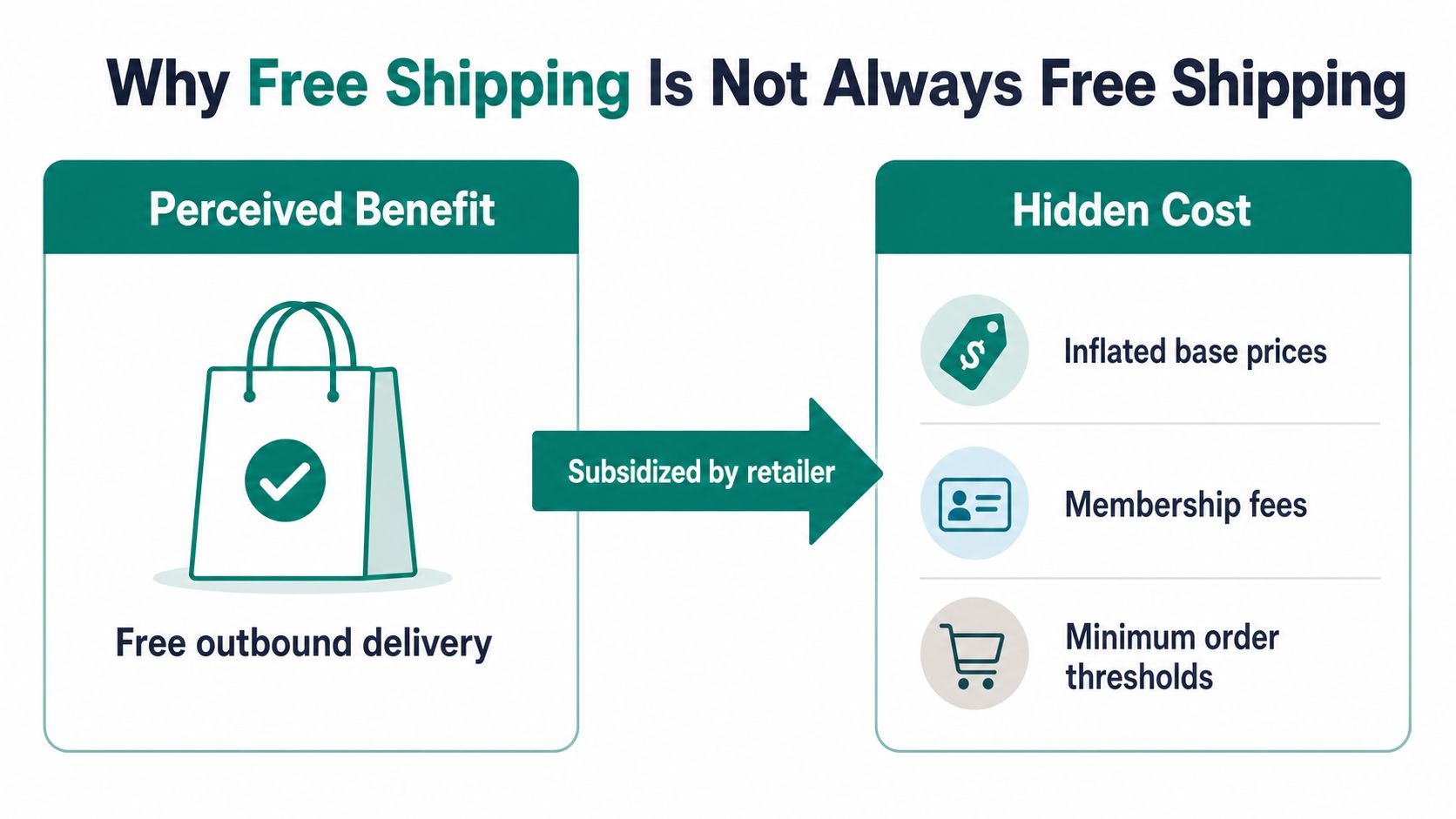
The most important hidden cost is often the return. A consumer guide reported that apparel return-shipping fees commonly fall around $4.95 to $9.99 at many stores, as described in ConsumerAffairs' 2025 return-shipping coverage. A shopper may see free delivery at checkout, then discover that the retailer deducts a label fee from the refund.
Where the cost can reappear
- Base pricing: A retailer may build fulfillment costs into product prices. You can't assume this happened, but comparing similar products helps reveal the full purchase price.
- Membership fees: “Free shipping for members” still has a cost if access requires a paid plan.
- Excluded merchandise: Heavy, oversized, made-to-order, or final-sale items may use different terms.
- Regional charges: Alaska and Hawaii can have separate delivery rules or surcharges.
- Refund deductions: A return label, restocking charge, or outbound shipping deduction can reduce the amount you receive.
- Final-sale restrictions: A low price and free outbound delivery don't help if the item cannot be returned.
The phrase “free returns” also needs examination. A retailer may provide a free in-store return but charge for mail-in returns. Another may offer a prepaid label while deducting its cost from the refund. Some policies offer free exchanges but charge when you want cash back.
Calculate the all-in cost, not just the shipping line. That means product price, tax, membership cost, possible return deductions, and the time required to package and send an unwanted item. A free delivery offer can be worthwhile, but only after you know which parts of the journey the retailer subsidizes.
Apparel Returns Fit and the Hidden Cost of Exchanges
Apparel creates a special shipping problem because shoppers can't test fabric, compression, rise, sleeve length, or shoulder width through a screen. Activewear adds movement to the fit question. A garment may look right standing still but feel restrictive during a squat, run, stretch, or overhead press.
That uncertainty helps explain why apparel returns commonly run around 23% to 30%, compared with general online retail benchmarks around 16.9% in 2024, according to Opensend's return-shipping statistics. The percentage isn't a prediction for every store, but it shows why return terms deserve the same attention as delivery speed.
Follow the exchange from start to finish
A typical exchange can involve several separate costs and delays:
- The retailer sends the original order, possibly with free outbound delivery.
- You identify a fit problem and request a return or exchange.
- You print a label, package the item, and hand it to the carrier.
- The retailer receives and inspects the return.
- The replacement ships, or the refund is processed before you place a new order.
The replacement can arrive later than a fresh purchase because the retailer may wait for the original item to return. Some instant-exchange programs send the replacement sooner but place a temporary authorization on your payment method. Brand credit may arrive faster than a cash refund, but it limits where you can spend the money.
Reduce fit uncertainty before ordering
Use the garment's measurements rather than relying only on your usual size. Check whether the product runs oversized, relaxed, fitted, cropped, or compressive. For oversized tees, compare your measurements with the women's oversized tee size chart before choosing a size.
Read fit reviews for recurring details such as narrow shoulders, long sleeves, a short torso, or fabric that feels less stretchy than expected. Order one carefully chosen size when the return policy is unclear instead of automatically bracketing several sizes.
A fast delivery only saves time if the first item fits. The cheapest exchange is the one you avoid through better measurements and clearer expectations.
How to Verify a Fast and Free Offer at Checkout
You have a cart ready, a banner promising fast and free delivery, and only one question: does that promise apply to your order? Treat checkout like a contract review. The banner attracts attention, while the policy supplies the conditions that decide whether the offer works for your items, location, and total.
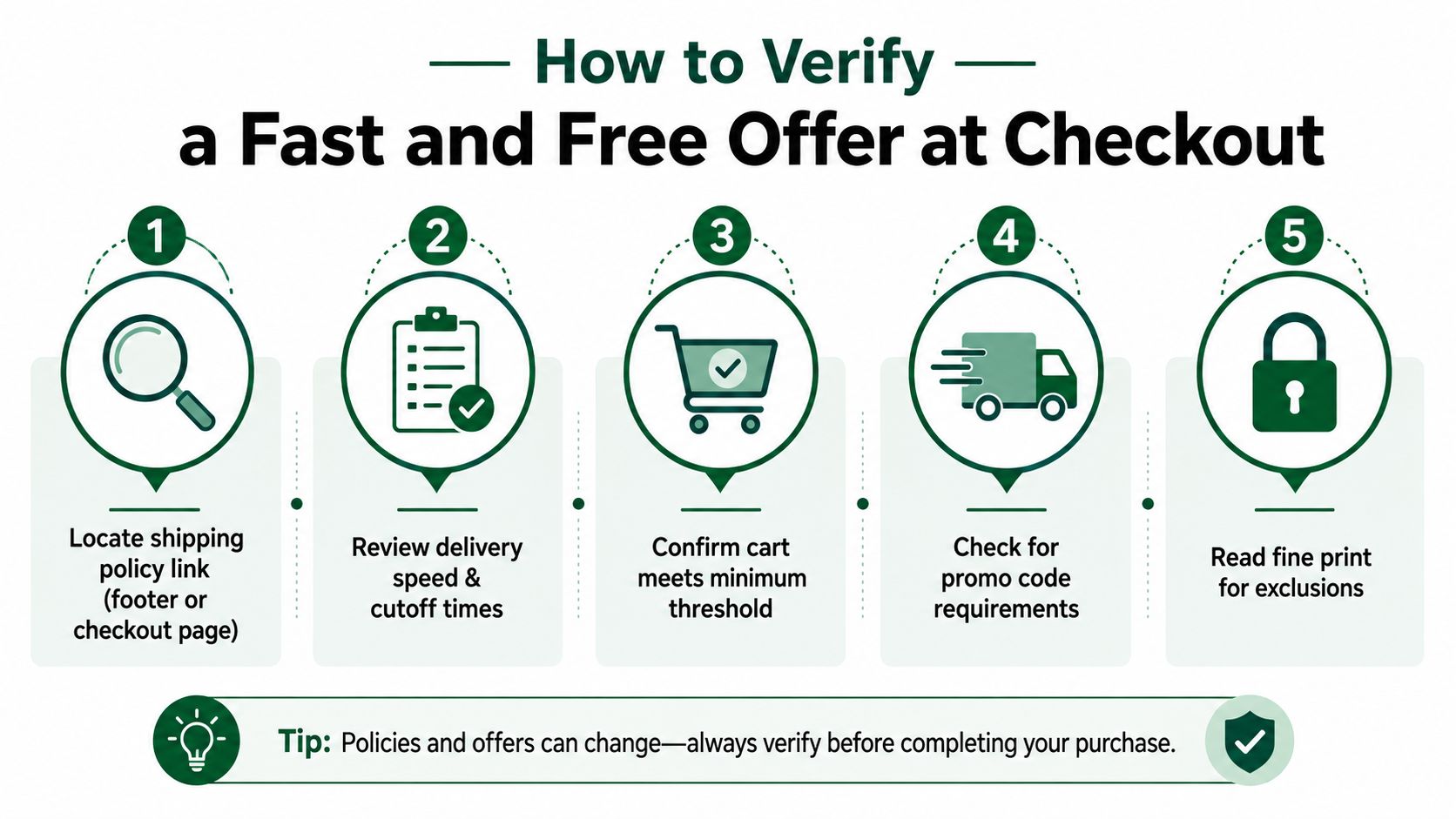
Five checks before you pay
- Find the policy. Check the footer, cart sidebar, product page, and checkout screen. A homepage banner may be broader than the detailed terms.
- Confirm the date. Separate processing time from carrier transit. Check the order cutoff and whether weekends are included in the displayed estimate.
- Check the threshold. See whether the minimum is calculated before or after discounts, and whether every product qualifies. Taxes may not count toward the subtotal.
- Test the promotion. Apply your discount code, then watch the shipping line. A code can lower the subtotal or remove free-shipping eligibility.
- Scan exclusions. Look for final-sale items, gift cards, oversized products, made-to-order goods, PO boxes, and noncontiguous U.S. destinations.
A progress bar showing how much remains for free shipping is useful, but it also encourages a larger cart. Compare the price of one more item with the actual delivery charge. If the extra garment will sit unused or introduce another fit risk, paying for shipping may cost less overall.
Enter your ZIP code before deciding. Shipping zones can change both the estimated date and the available services. If a carrier selector appears, compare promised arrival dates instead of assuming the highest-priced option is necessary.
For item-specific rules, exchanges, or order changes, review the retailer's frequently asked questions. Save a screenshot of the checkout promise when timing matters, particularly if a promotion changes the visible terms.
A short walkthrough of the checkout verification steps shows how the five checks appear in practice, including the policy, delivery estimate, threshold, promotion, and exclusions. Watch the checkout verification walkthrough before placing an order if any term remains unclear.
Smart Habits for Getting the Best U.S. Delivery Deals
The strongest shipping strategy is less about chasing a flashy banner and more about controlling the variables you can control. Shop before the weekend cutoff when timing matters, group planned purchases, and read the return policy before selecting a size.
Four habits that protect your budget
- Time the order: If you're close to a warehouse cutoff, place the order earlier rather than assuming the clock uses your local time. The retailer's warehouse time controls processing.
- Bundle intentionally: Combine activewear staples you already need into one order when doing so clears the threshold without padding the cart.
- Compare membership value: A shipping membership can help frequent shoppers, but include the membership charge and return rules in your calculation.
- Watch for promotions: Sign up for retailer emails or alerts if you're willing to wait for a free-shipping promotion. Don't let an alert push you into buying an item you don't need.
Carrier tracking gives you useful context after shipment. It can show whether the parcel has been accepted, moving between facilities, or delayed. It won't eliminate the retailer's processing time, but it can help you distinguish a warehouse delay from a carrier delay.
Location also affects practical speed. A warehouse closer to your ZIP code may deliver standard service sooner than a distant facility, even when both retailers use similar wording. That's why the checkout estimate for your address is more valuable than a general promise shown before you enter delivery details.
The same logic applies to returns. A retailer that explains its return window, label options, exclusions, and refund timing may offer more real value than one that advertises free outbound delivery but hides the cost of sending items back. Shipping clarity is part of product value, particularly for fit-sensitive tees, shorts, hoodies, and performance layers.
If you're shopping for fitness and athleisure pieces, From: Me Fitness Apparel offers U.S.-focused free-shipping messaging, easy returns and exchanges, and a catalog of graphic and performance tops, hoodies, shorts, outerwear, and accessories. Visit the store, review the delivery and return terms for the items you're considering, and choose an order that meets your training needs without relying on an unclear shipping promise.